
// Tool Selection & PoC




// Tool Decisions Made on Demos, Not Evidence
Every vendor's demo looks great. The gap between the pitch and your actual codebase is where expensive mistakes happen.
Decision Paralysis
Dozens of credible-looking tools, no structured way to compare them against your specific stack and team.
Evaluating Marketing, Not Fit
Feature comparison charts don't tell you how a tool behaves on your login flow, your checkout, your CI pipeline.
Wrong Tool, Expensive Rework
A bad choice costs months of migration and rebuilt suites later, far more than the evaluation would have cost upfront.
Team Buy-In Comes Too Late
Tools chosen without engineer input get adopted reluctantly, or quietly abandoned within a year.
A test automation tool selection process built on working code beats a vendor comparison chart every time.
// An Evidence-Backed Decision, Not a Guess
A Justified Decision
Flakiness metrics, integration results, and cost projections, ready to present to stakeholders.
Future-Proof Fit
Every candidate evaluated against your 18-24 month roadmap, not just today's requirements.
A Bought-In Team
Your engineers contributed code and saw the evidence, so adoption starts with buy-in, not skepticism.
A Migration Plan
If you're switching tools, a phased path: what moves first, how tests translate, how training is sequenced.
// Evidence Before Commitment
QA tool evaluation consulting done right means a working proof-of-concept, not a checklist review.
Requirement Mapping
We start from your must-haves: language, integrations, team skills, CI/CD fit, not a generic feature list.

Real Code, Real Stack
Working frameworks built on your actual product flows, not a vendor's demo application.

Measured, Not Assumed
Flakiness, execution speed, and integration friction, benchmarked across multiple runs.

Vendor-Neutral
No licenses resold, no referral fees. The recommendation follows the evidence, not a partnership.

// Four Phases, Clear Gates
Selection
//01Filter to top 2 contenders, define a golden-path test journey. 3-5 days.
Implementation
//02Build working frameworks, 20-50 representative tests, CI/CD integration. 1 week.
Benchmarking
//03Run suites repeatedly, measure flakiness, speed, and scaling behavior. 3 days.
Decision & Migration Plan
//04Go/no-go recommendation backed by evidence, plus a scale-up path. 3-5 days.
// Proven in the Real World.
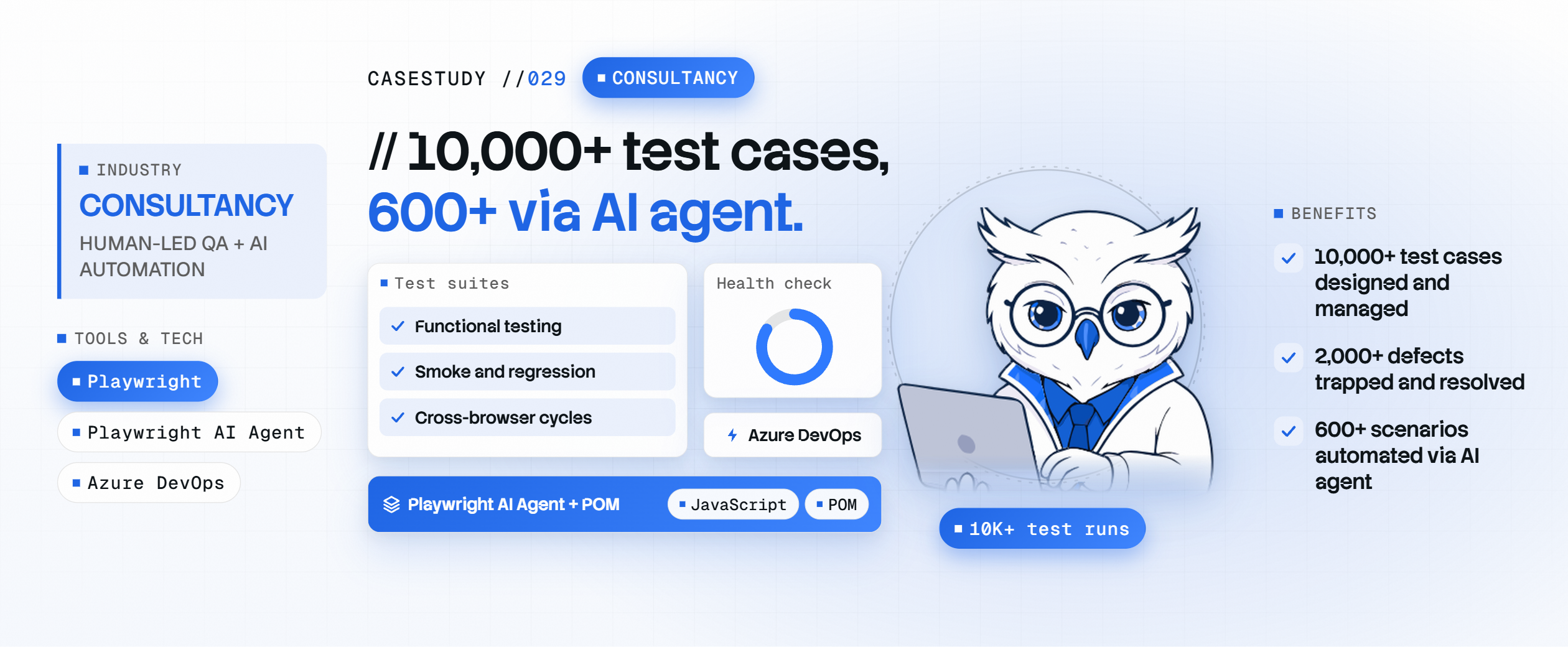
// Automation Tool Assessment,
at Your Pace
Rapid Shortlist Review
A fast, desk-based evaluation of 3-5 candidate tools against your stated requirements, no PoC build.
Best For:Early-stage decisions, or narrowing a long list before committing to a PoC.
Includes:Requirement map, comparison scorecard, a recommended shortlist of 2.

// One Node in Your Transformation Journey
// Latest Articles.

// Questions, Answered.
What is test automation tool selection and PoC engineering?
A vendor-neutral evaluation that shortlists candidate tools against your actual requirements, then builds a working automation framework in each on your own codebase, measured for flakiness, speed, and integration, before you commit budget.
How is this different from reading vendor comparisons or review sites?
Review sites compare marketing claims. A PoC compares working code on your product, your login flow, your checkout, your CI pipeline. Evidence from your own stack beats a five-star review every time.
Is the recommendation vendor-neutral?
Yes. We don't resell licenses or take referral fees from tool vendors. The recommendation follows purely from how each tool performed against your requirements.
What if we're migrating from an existing tool, not starting fresh?
Common scenario. We benchmark candidates against your current tool directly, on the same test scenarios, and deliver a phased migration plan: what moves first, how tests translate, how training is sequenced.
Does the evaluation consider AI-readiness?
Yes. Every tool is assessed with an 18-24 month horizon in mind, including whether it supports AI-assisted test generation and integrates with autonomous orchestration, not just whether it works today.
Will our team be involved in the evaluation?
Yes, and it matters. Your engineers see the evidence and contribute code during the PoC, so when a tool is chosen, the team is bought in rather than skeptical of a decision made without them.
What happens if none of the shortlisted tools work well?
That's a valid outcome, not a failure. The benchmarking data still tells you what your requirements actually demand, and we expand the shortlist rather than force a poor fit.