
// QE Maturity Assessment




// Most Teams Are Optimizing the Wrong Things
Quality engineering maturity is a foundation, not a nice-to-have. Most organizations chase metrics that don't matter and miss the risks that do.
Optimizing Vanity Metrics
Coverage percentage and pass rates don't drive business outcomes. Mature QE optimizes for release confidence and defect prevention instead.
Automation Without ROI Visibility
Suites are brittle, duplicated, high-maintenance, and no one can say whether they're actually reducing risk.
Release Confidence Is Gut-Feel
"We're ready to ship" with no data behind it. One surprise defect undermines credibility with stakeholders.
AI Adoption Blocked by Weak Foundations
Without test data governance, observability, or CI/CD integration, AI-driven testing can't actually deliver.
// Five Levels of Quality Engineering Maturity
Reactive QA — The Firefighting Phase
Manual testing dominates, defects surface late, releases depend on individual heroics.
Automated QA — The Script-Building Phase
Automation exists but is brittle and high-maintenance. Coverage grows, but ROI is hard to prove.
Engineered QE — The Architecture Phase
Automation is scalable, risk-based testing emerges, shift-left practices begin, roles are defined.
Intelligent QE — The Data-Driven Phase
Testing decisions are evidence-based. Production quality signals feed predictive risk analysis.
Autonomous QE — The Self-Optimizing Phase
Pipelines adapt to risk signals on their own. AI orchestrates test selection and anomaly detection continuously.
// Five Concrete Deliverables
QE Maturity Scorecard
Overall level (1-5) with a dimension-by-dimension breakdown.
Gap Analysis Report
What's working, what's behind, and the root cause of each gap.
Risk Heatmap
Business risk tied to each gap, ranked by impact on release confidence.
Prioritized Roadmap
A phased 12-18 month plan with effort, ROI, and success metrics per initiative.
AI Readiness Insights
What foundational capabilities you need before AI-driven testing pays off.
// Six Dimensions of Quality Engineering Maturity
The quality engineering assessment services cover every layer that determines whether you can ship with confidence.
Strategy & Governance
Is quality strategy written, aligned to business goals, and executively sponsored, or ad-hoc?

Test Engineering & Automation
How scalable and maintainable is your automation architecture, coverage strategy, and SDET practice?

AI & Intelligence Readiness
Data collection, analytics infrastructure, and team capability to adopt intelligent testing.

DevOps & CI/CD Integration
How tightly quality gates and feedback loops are built into your deployment pipeline.

Test Data & Environment Management
Provisioning speed, environment parity, and data governance for compliance.

Observability & Insights
Whether production quality signals actually feed back into what you test next.

// A Structured Four-Phase Engagement
Discovery
//01Interviews, surveys, document and tooling review. 1-2 weeks.
Capability Mapping
//02Map current state to the five-level model across all six dimensions.
Risk & Impact Analysis
//03Quantify what each gap costs in release risk and business impact.
Scoring & Roadmap
//04Deliver your maturity scorecard, benchmarks, and prioritized roadmap.
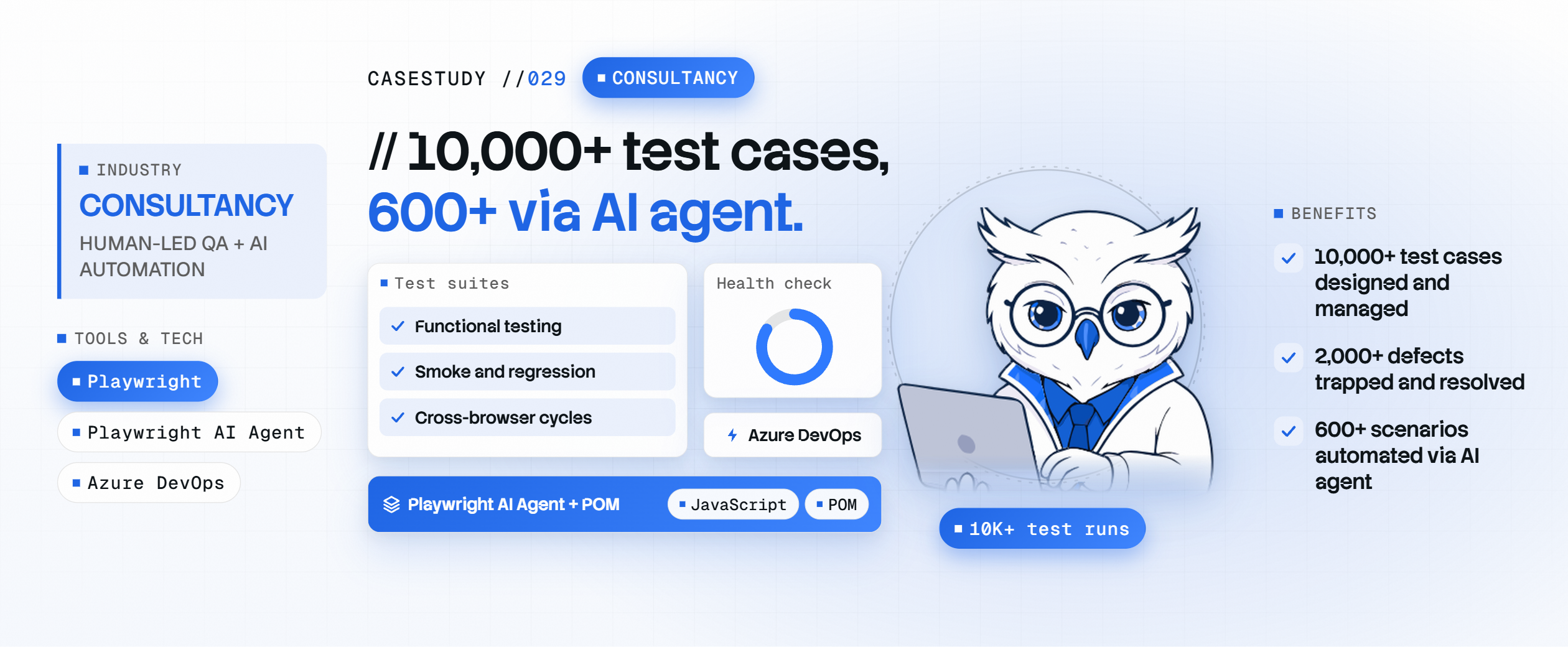
// Proven in the Real World.
// Three Assessment Models
Fit your scale and how far along your QE transformation already is.
Rapid Assessment
High-level maturity scoring and quick-hit recommendations, done in 2-3 weeks.
Best For:Teams new to QE maturity thinking, or wanting a baseline first.
Includes:Discovery interviews, capability mapping, preliminary scorecard, top 5 recommendations.

// How This Fits Your QE Journey
// Latest Articles.

// Questions, Answered.
What is a QE maturity assessment and how is it different from a QA audit?
A QA audit measures conformance to standards, like test coverage or pass rates. A QE maturity assessment measures organizational capability and business impact, how systematically you engineer quality into products, across strategy, automation, AI readiness, DevOps, test data, and observability.
What are the levels of quality engineering maturity?
Five: Reactive QA (manual, late defects), Automated QA (brittle scripts), Engineered QE (scalable, risk-based), Intelligent QE (data-driven decisions), and Autonomous QE (self-optimizing, AI-orchestrated pipelines).
How long does the assessment take?
A rapid assessment takes 2-3 weeks. A deep-dive assessment takes 4-6 weeks and adds detailed risk analysis, a full roadmap, and peer benchmarking.
Who should participate?
Ideally executive sponsorship, QE and QA leadership, automation engineers, DevOps engineers, and one or two product leaders, typically 10-15 people, interviewed 45-60 minutes each.
Who is this assessment for?
CTOs and VPs of Engineering get evidence-based release confidence. QE and QA leaders get a roadmap for their function. Product leaders get quantified release risk. Investors and boards use it as due diligence on whether QE can scale with growth.
Is this tool-agnostic?
Yes. Recommendations focus on capability, not specific tools, Selenium, Cypress, Playwright, or a cloud-based test service, the roadmap is about architecture and practice, not brand.
Does this work with Agile, Waterfall, or Kanban?
Yes. The five-level model applies regardless of methodology. Agile and waterfall teams score on different specifics, but the framework and roadmap respect whichever methodology you already use.
Will this disrupt our team?
Minimally. It runs alongside normal work, roughly 5-10 hours per week of team time for interviews and feedback sessions, no disruption to production or deployments.
How often should we re-assess?
Every 6 months while actively transforming, to track progress and re-prioritize. Once you've hit your target level, an annual re-assessment is usually enough.