
// Modern Test Strategy




// Why Traditional Test Strategies Break Down
A strategy written once for a monolith becomes a liability the moment your architecture changes underneath it.
Regression Blocks Continuous Delivery
A monolith-era strategy applied to microservices limits deployment to one change per day, not per service.
Written Once, Never Adapted
Test plans built years ago don't account for the distributed systems your architecture has since become.
Manual Hand-Offs Create Gaps
Coordination between teams introduces delay and inconsistent coverage at every service boundary.
Coverage Measured by Volume
More tests isn't more confidence. Without risk-weighting, effort goes where it's easy, not where it matters.
Modern test strategy consulting redesigns the strategy around your actual architecture, not the one you had two years ago.
// A Strategy Your Team Can Act On
Test Strategy Blueprint
The full architecture-aware strategy document, ready for your engineering leadership.
Coverage & Risk Model
Which flows need thorough coverage, which don't, and why, backed by actual risk analysis.
Tooling Alignment Guide
How your existing automation and tools map onto the new strategy, and where the gaps are.
Metrics & Signal Framework
What to actually measure so you know the strategy is working, not just that tests are running.
// Strategy for Complex Application Landscapes
Different application types demand fundamentally different testing approaches.
Microservices
Contract testing, service isolation, chaos engineering, and consumer-driven contracts for dozens of independently deployed services.

Event-Driven Systems
Message validation, async flow testing, state management checks, and dead-letter-queue testing for decoupled services.

Cloud-Native
Infrastructure-as-code validation, on-demand environments, parity checks, and configuration drift detection.

Mobile & Cross-Platform
Device matrix strategy, network simulation, localization validation, and accessibility testing across thousands of combinations.

AI & ML Systems
Distribution validation, drift detection, bias testing, and graceful degradation checks for probabilistic outputs.

// What a Modern Test Strategy Really Means
Enterprise test strategy design built on four principles, not a static document.
Architecture-Aware
//01Designed around your system architecture, not a generic template applied regardless of how you actually ship software.
Risk-Based Coverage
//02High-risk flows get thorough coverage. Lower-risk features get lighter coverage. Intent behind every test.
Shift-Left & Shift-Right
//03Testing starts before code is written and continues with observability after release, not just at the middle.
Built to Evolve
//04The strategy adapts as your architecture changes, it isn't a document that goes stale in a drawer.
// Proven in the Real World.
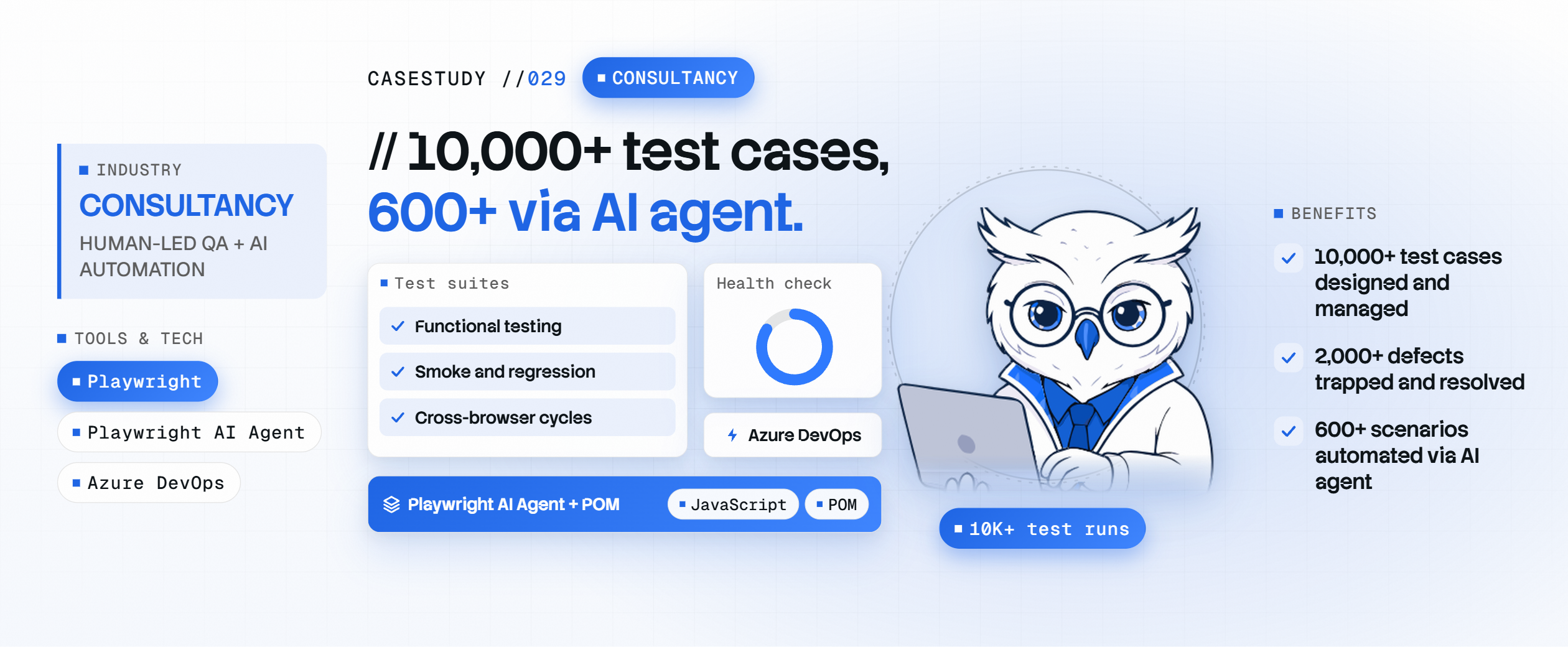
// Test Strategy Consulting Services,
Scoped to You
Strategy Assessment
A review of your current test strategy against your actual architecture, surfacing where it no longer fits.
Best For:Teams unsure whether their existing strategy still holds up.
Includes:Architecture-fit review, gap report, prioritized recommendations.

// How Modern Test Strategy Fits in QE Consulting
// Latest Articles.

// Questions, Answered.
What makes a test strategy "modern" versus traditional?
A traditional strategy is written once and measures coverage by volume. A modern one is architecture-aware, risk-based, adapts as your system changes, and balances shift-left and shift-right rather than testing everything at the end.
Our architecture changed, does our old strategy still work?
Usually not well. A strategy built for a monolith becomes a liability once you split into microservices or move to event-driven patterns. It needs to be redesigned around the new architecture, not just have more tests added.
Does this cover microservices and event-driven systems specifically?
Yes. Microservices get contract testing and service isolation. Event-driven systems get message validation, async flow testing, and dead-letter-queue testing, each pattern gets a strategy suited to its failure modes.
How is risk-based coverage different from testing everything?
It identifies high-impact flows, payments, authentication, reporting, and ensures thorough coverage there, while lower-risk features get lighter coverage, focusing effort on what actually matters.
Does the strategy account for AI and ML components?
Yes. AI and ML systems need distribution validation, drift detection, bias testing, and graceful degradation checks, approaches a conventional deterministic-system strategy doesn't cover.
How often does the strategy need revisiting?
It's designed to evolve with your architecture rather than sit static. Most clients revisit it at major architecture shifts, and a lighter annual review is worthwhile even without one.
What's included beyond the strategy document itself?
A coverage and risk model, an automation and tooling alignment guide, CI/CD integration guidance, and a metrics and quality signal framework, so it's something your team can act on, not just read.