
// Synthetic Data Engineering




// Real-World Data Is Messy, Sparse, and Risky
Rare conditions, edge cases, and adversarial scenarios rarely exist in enough volume in production data, and using real data at all carries compliance risk.
Too Sparse for Real Coverage
Rare conditions and edge cases don't show up often enough in production to test against reliably.
Real Data Is Compliance Risk
Patient records, financial details, and PII shouldn't sit in test environments at all.
Manual Fixtures Don't Scale
Hand-crafted test data tops out at a few hundred scenarios, nowhere near enough for real validation.
Bias Hides in Small Samples
Limited real-world data can't reveal demographic bias the way a deliberately balanced dataset can.
Synthetic data engineering solves realism and compliance at the same time, not one at the expense of the other.
// Engineered, Not Random
Purpose-Built
Generated for specific test scenarios and coverage goals, not arbitrary volume.
Statistically Faithful
Preserves real correlations and distributions without exposing any real record.
Privacy-Preserving
No real patient, financial, or user data present at any point, by design.
Bias-Aware
Built with deliberate, balanced demographic coverage to surface gaps real samples hide.
// Four Ways We Generate Synthetic Data
Generative Adversarial Networks
Two competing networks produce data statistically indistinguishable from the original, for tabular, image, and transactional types.

Statistical Fidelity Engineering
Preserves correlations and business logic across databases and microservices without touching source data.

LLM-Augmented Text Synthesis
Generates nuanced conversational text and edge-case inputs to test semantic understanding and prompt robustness.

Relational Integrity Preservation
Maintains parent-child relationships and cross-service coherence, so it works in your real environment.

// Five Steps From Scope to Delivery
Scope & Requirements
//01Define coverage goals, edge cases, and compliance constraints upfront.
Statistical Modeling
//02Learn the distributions and correlations that need preserving.
Data Generation
//03Apply the right technique per data type, at the volume you need.
Validation & Bias Check
//04Confirm fidelity, coverage, and balanced representation before handoff.
Delivery & Documentation
//05Dataset plus compliance-ready documentation for your audit trail.
// Built for Responsible AI, Not Bolted On
GDPR & HIPAA Ready
Zero real personal or health data involved, removing the exposure entirely rather than just masking it.
Audit-Ready Documentation
Full generation methodology documented for compliance and regulatory review.
Bias Detection Built In
Demographic balance checked as part of generation, not as an afterthought.
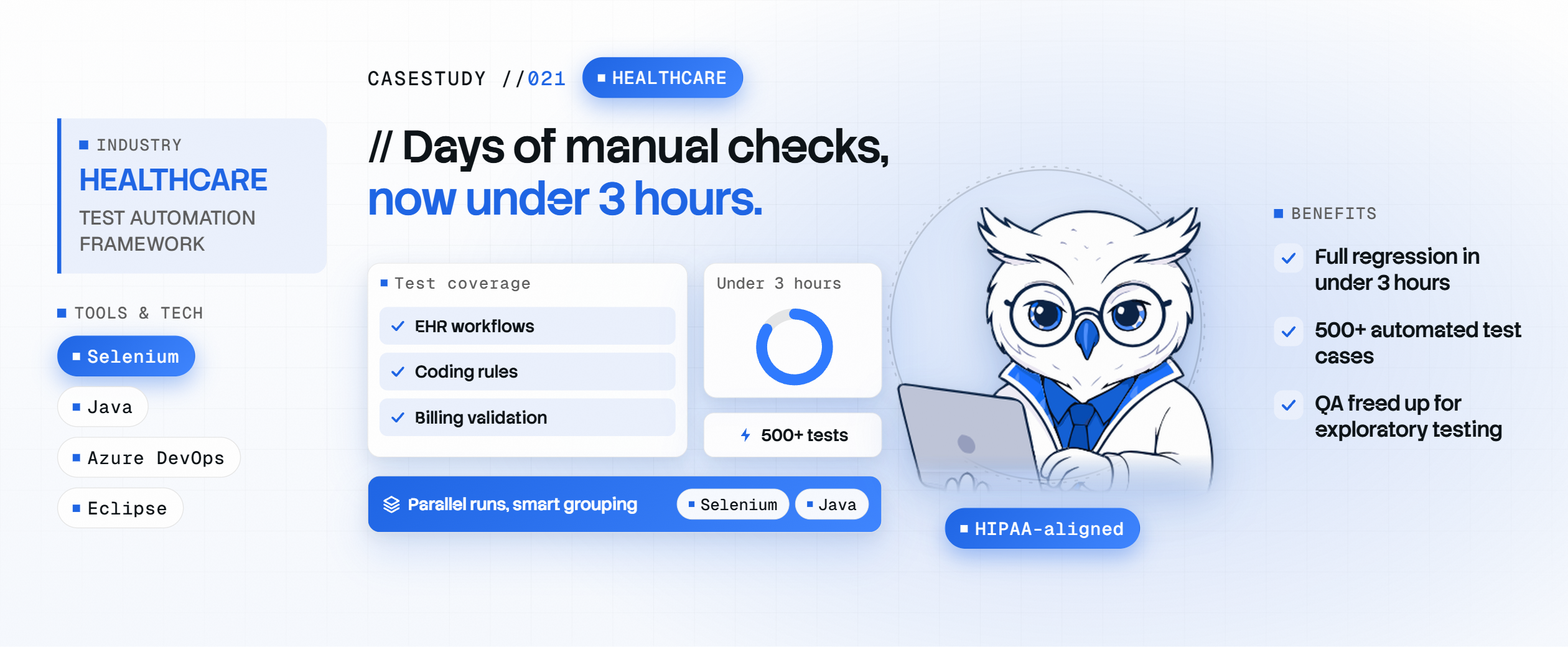
// Proven in the Real World.
// Three Engagement Models
Scoped Data Build
A single dataset generated for one defined test scenario or data type.
Best For:Teams with one clear gap, like a rare-condition dataset or a stress-test scenario.
Includes:Requirements scoping, generated dataset, validation report.

// Where This Fits in AI App Assurance
// Latest Articles.

// Questions, Answered.
What is synthetic data engineering?
The discipline of generating purpose-built, statistically faithful data for specific test scenarios, not random noise, and not a copy of real records with names swapped out.
How is this different from regular QA test data?
General QA test data supports functional and regression testing. Synthetic data for AI testing is engineered for AI assurance specifically: model validation, prompt and guardrail testing, agent simulation, and bias detection.
Can synthetic data train models, not just test them?
Yes, once validated for statistical balance and coverage. AI training data services increasingly rely on the same engineered datasets used for testing.
Does this actually protect patient or customer privacy?
Yes, when engineered correctly. No real record is present at all, statistical properties are preserved without exposing any individual's actual data.
How much can you generate, and how fast?
Scale depends on technique and data type, engagements have generated over 150,000 records for one project. Timelines run 3-6 weeks depending on complexity.
Can this help detect bias we didn't know we had?
Yes. Deliberately balanced demographic representation and rare-condition coverage surface bias gaps that limited real-world samples never would have revealed.
Who is this for?
Teams building or testing AI in regulated domains like healthcare and finance, teams short on real edge cases, and anyone needing to test rare or adversarial scenarios safely.