
// API Contract Testing Services




// Integration Hell: Why Your Teams Are Stuck
The Dependency Trap
Team A can't test because Team B's service is down. Waiting rooms and blocked dependencies stall every sprint.
The Silent Breaking Change
A backend field gets renamed, the frontend crashes in production, and nobody sees it coming.
Environment Bloat
Massive staging environments exist just to run integration checks, burning cloud budget and team time.
Jignect builds API contract testing that catches breaking changes before they ever reach a shared environment.
// The 4 Pillars of API-First Excellence
Consumer-Driven Contract Testing
Consumers define the contract in tools like Pact, and the provider is tested against it on every build.
Service Virtualization & Mocking
High-fidelity mocks for third-party and internal services remove the wait, and let you test edge cases real environments can't trigger.
Schema-First Validation
OpenAPI and Swagger specs are validated automatically, so documentation and code never drift apart.
Security-First API Audits
Automated scans for broken object-level authorization and mass assignment risks, built into every suite.

// Proven Technologies & Standards


// Deliverables, Not Just Test Runs
Consumer-Driven Contract Suite
Contracts your provider is tested against on every build, not just at release time.
Service Virtualization & Mocks
High-fidelity mocks so teams build in parallel instead of waiting on each other.
Schema Validation Pipeline
Automated checks that catch spec drift the moment it happens.
API Security Audit Reports
Clear findings on authorization and data-exposure risk, ready for your next release review.
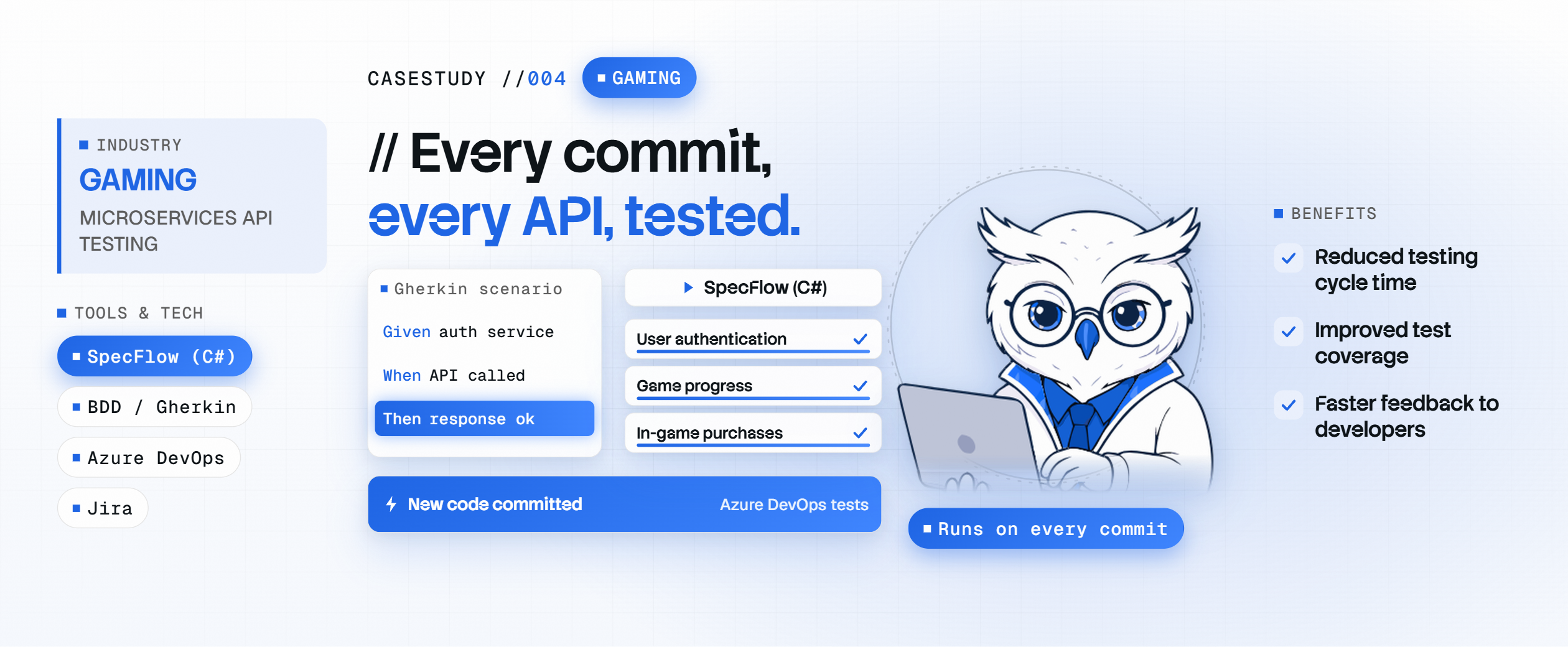
// From Integration Weeks to Same-Day Deploys.
// Latest Articles.

// Questions, Answered.
Who is API Contract Testing built for?
It's built for teams whose services frequently break each other's work mid-sprint; organizations where integration testing is slow, unstable, or both; releases that require heavy manual coordination across teams; and teams building microservices that deploy independently of each other.
How is contract testing different from regular API testing?
Regular API testing validates that an API works in isolation. Contract testing services validate that a provider and consumer agree on the interface, and that agreement is enforced automatically on every change.
What is contract testing and why does it matter for microservices?
Contract testing ensures independently deployable services stay compatible with their consumers. Without it, microservices become a web of hidden dependencies that cause production chaos.
Do we need to change our code to run API contract testing?
No. It is a testing practice, not a coding requirement. Tools like Pact integrate with your existing test frameworks and CI/CD pipelines.
What types of APIs can be covered?
REST, GraphQL, gRPC, Kafka, RabbitMQ, and other message-based protocols. Any synchronous or asynchronous API interaction can carry a contract.
How does API-first testing support Shift Left?
Contracts are verified early, in PR checks and CI, before code reaches staging. Bugs are caught immediately, not days later in integration.
We use GraphQL, can we still do contract testing?
Yes. Tools like Pact support GraphQL contracts. You define expected queries and mutations, and the provider is tested against those expectations.
Can this be integrated into CI/CD pipelines?
Yes. Contract tests are typically lightweight and run in milliseconds to seconds, making them a good fit for PR gates and branch protection rules.
Will this replace our end-to-end tests?
No. Contract testing is narrower and earlier. E2E tests still matter for full workflows, but contract testing removes the need for heavy staging environments.
How do you handle versioning and backward compatibility?
Contracts define versioning explicitly. Tests ensure new API versions stay compatible with old clients, or flag breaking changes for migration planning.
Does this work with third-party or external APIs?
Yes. You can write contracts for third-party APIs and use service mocks to simulate their behavior, so your code adapts correctly when they change.