
// AIOps for QA Services




// Production Generates Noise. AIOps Extracts Signal.
Alert Fatigue Is Real
Modern systems generate thousands of alerts. Teams spend more time triaging false positives than fixing real issues.
Root Cause Is Hidden in Context
A latency spike here, a connection spike there, a deploy somewhere else, all related. Human analysis misses multi-signal root causes.
Test Prioritization Is Guesswork
Without production data, test prioritization relies on intuition instead of where real risk actually lives.
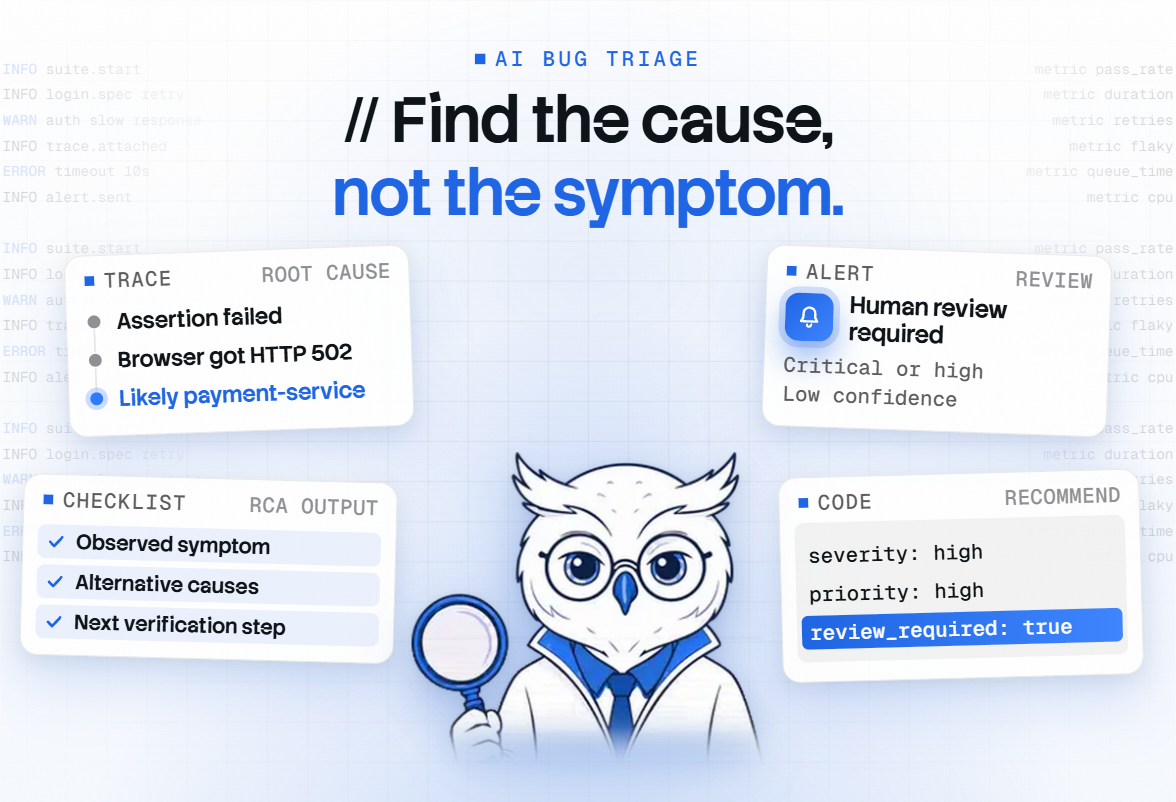
Our AIOps testing services separate real regressions from expected noise, at a scale no human triage keeps up with.
// Four Pillars of AI-Driven QE
Anomaly Detection
ML-based detection of metric deviations across latency, error rate, and throughput, beyond static thresholds.
Root Cause Correlation
Multi-signal analysis across services and deployments that generates ranked root cause hypotheses.
Predictive Failure Analysis
Pattern recognition on historical incidents surfaces early warning signals before failures become user-visible.
Test Prioritization Intelligence
Production failure data feeds back into QE, prioritizing regression tests by actual risk, not heuristics.

// Works With Your Stack


// Deliverables, Not Just an Alert Feed
Unified Signal Integration
APM, logs, metrics, traces, and test history connected into one corpus for AI analysis.
Anomaly Baseline & Detection
Models trained on your system's normal behavior, tuned to catch real deviations.
Root Cause Correlation Reports
Ranked hypotheses that cut MTTR from hours to minutes.
Test Intelligence Feedback Loop
Regression priorities and flaky-test flags fed straight back into your QE dashboard.
// Stop Reacting to Production Failures. Start Predicting Them.
// Latest Articles.

// Questions, Answered.
Who is AIOps for QA built for?
It's built for teams drowning in alert fatigue and false-positive triage; teams whose root cause analysis takes hours across multiple services; teams testing based on intuition instead of production failure data; and teams wanting failures predicted before the P1, not diagnosed after.
What's the difference between AIOps and traditional monitoring?
Traditional monitoring uses static thresholds. AIOps testing services use machine learning to establish behavior baselines, detect deviations, correlate multi-signal patterns, and predict anomalies before users are affected.
Do you need access to our production systems to implement AIOps for QA?
No direct access is needed. We integrate with your existing observability stack and consume the data it already collects, so there are no agent installations or added security surface.
How long does it take to train the anomaly detection models?
Baseline models can establish normal patterns in 1 to 2 weeks. For critical services we recommend 4 to 6 weeks to capture seasonal variation, with models continuously adapting after that.
Can AIOps for QA work with our existing Datadog or New Relic setup?
Yes. It's platform-agnostic and integrates natively with Datadog, Dynatrace, New Relic, Grafana, and Prometheus, with no rip-and-replace required.
How does production failure data actually feed back into our test suite?
We correlate incident-involved journeys and integrations with your test execution history, generating priority recommendations that integrate with TestRail, Zephyr, or Xray.