
Every engineering leader has felt the tension at some point. The product roadmap grows. Release velocity increases. The development team ships more features per sprint than it did six months ago. And the QA team, the same size it was a year ago, starts to become the thing standing between the software and the customer.
The default response to this tension has always been the same: hire more QA engineers. More tests need to be written, so you need more people to write them. More coverage is needed, so you need more hands to build it. The logic is straightforward, and for most of software engineering history, it was the only option available.
That logic is now outdated. Not because QA engineers are less valuable, but because the constraint that made headcount the only lever has changed. The bottleneck in traditional QA was never the judgment or the expertise of the team. It was the mechanical work that absorbed the majority of their time: writing test scripts from scratch, maintaining them as the UI evolved, triaging failures one by one, generating test data manually, running regression cycles by hand. That mechanical work, which consumed sixty to seventy percent of most QA engineers’ time, can now be handled by AI at a fraction of the cost and a fraction of the time.
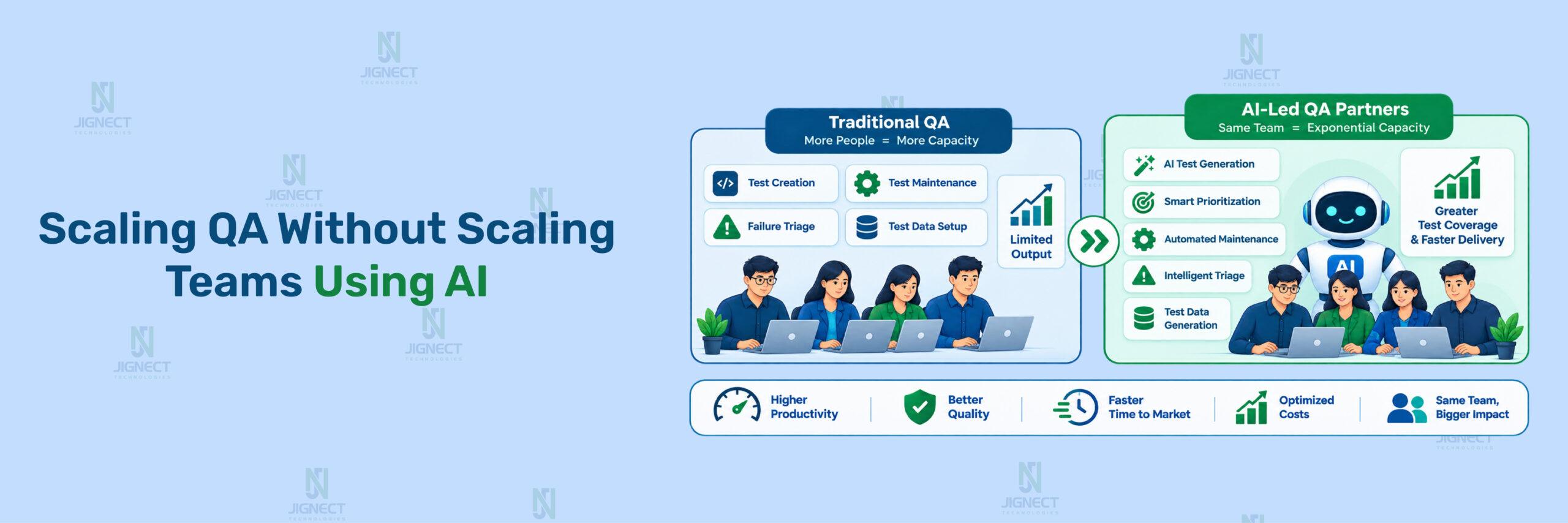
Scaling QA without scaling teams is not about doing the same work with fewer people. It is about removing the mechanical work entirely, so the people you have can do ten times more of the work that actually requires their expertise. This blog explains how that shift happens, what it looks like in practice, and what the organisations doing it successfully have in common.
- 1. Why the Traditional Scaling Model Has Run Out of Road
- 2. The Four Bottlenecks That Make QA Headcount-Dependent
- 3. Scaling Is a Model Change, Not a Volume Change
- 4. The Six AI-Driven Levers That Replace Headcount
- 5. What Scaled QA Actually Looks Like in Practice
- 6. The Metrics That Show You Are Scaling, Not Just Busy
- 7. The Three Phases of the Scaling Journey
- 8. What Prevents Teams From Scaling (And How to Avoid Each Trap)
- 9. How JigNect Helps Organisations Scale QA Without Adding Headcount
- 10. Closing Thoughts
1. Why the Traditional Scaling Model Has Run Out of Road
The numbers that describe the current state of QA are not comfortable ones.
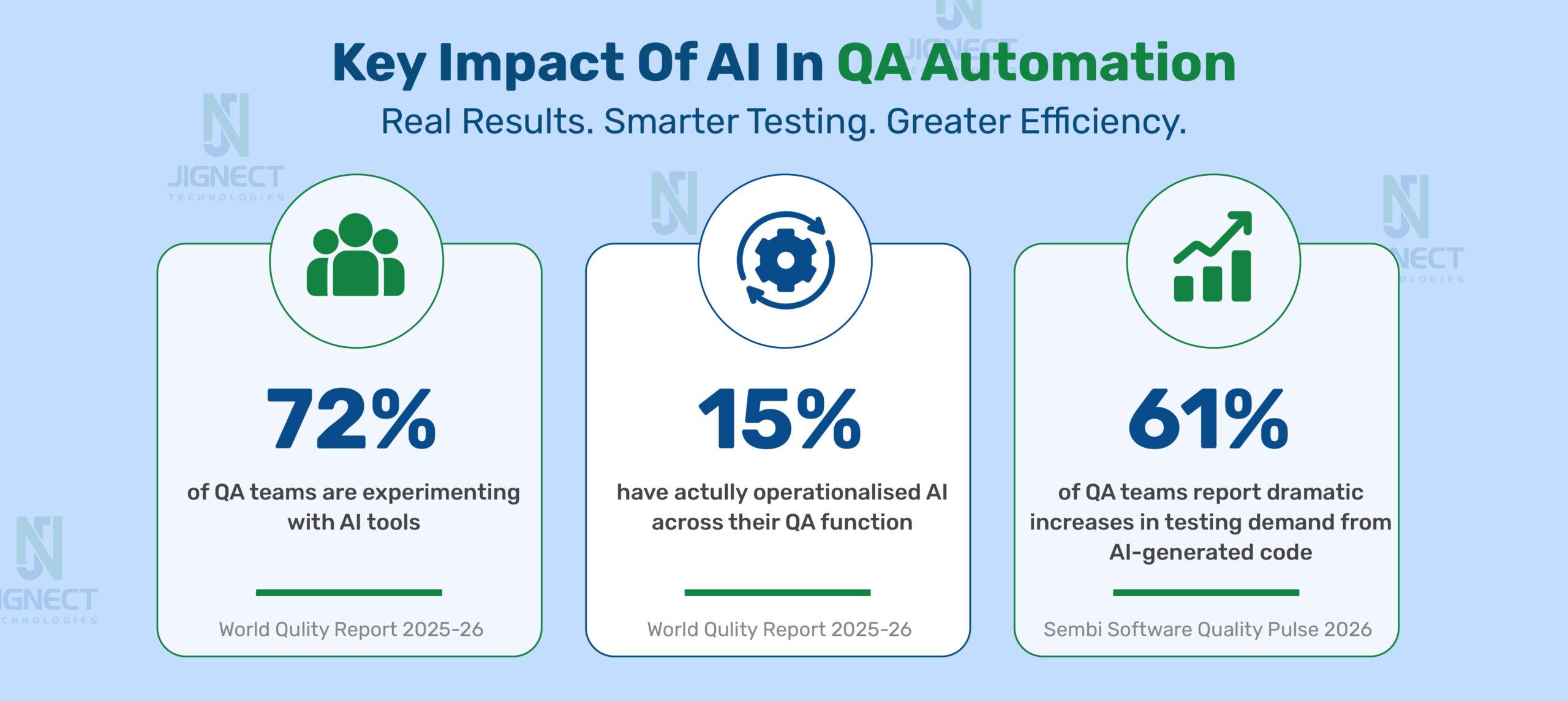
The gap between the 72% experimenting and the 15% who have scaled is the story. It is not a story about technology. The tools exist and most teams have access to them. It is a story about approach. The teams stuck in the gap are treating AI as a productivity feature layered on top of the existing QA workflow. They use AI to write tests a little faster, to help with a few manual tasks, to generate some test data when needed. The workflow stays the same. The bottlenecks stay the same. And the scaling problem stays the same.
The teams in the 15% who have actually scaled did something different. They did not ask “how can AI help us do what we currently do faster.” They asked “which parts of what we currently do should not require human time at all, and how do we remove those parts from the human workload entirely.” The answer to that question restructures the QA function at its foundation, not at its edges.
Scaling QA is a model change, not a volume change. You do not scale by writing more scripts faster. You scale by removing the scripting and maintenance bottlenecks entirely, so the team’s capacity for coverage grows without the headcount growing alongside it.
The development side of software delivery has already been through this shift. AI coding assistants have roughly doubled developer output in many engineering teams. Features that took three sprints now take one. The code review process has become faster. The implementation work has compressed. And the QA function, sized for the old pace, is now the bottleneck it never used to be. As one industry analysis put it bluntly in 2026: “Your developers got faster. Significantly faster. The QA function that was sized for one speed now operates at another.”
The traditional response, hire more QA engineers, is both slow and structurally inadequate. Hiring is expensive, it takes months, and it adds more people to a workflow that is itself the problem. Scaling QA requires changing the workflow, not staffing the existing one more heavily.
2. The Four Bottlenecks That Make QA Headcount-Dependent
Before addressing how AI removes the bottlenecks, it is worth being precise about what those bottlenecks actually are. Not all QA work is equally mechanical, and not all mechanical work is equally amenable to AI. Understanding where the headcount dependency actually lives allows a team to target the right places.
2.1 The Test Creation Bottleneck
Writing test code is the activity most directly tied to headcount in traditional QA. Every new feature needs new test cases. Every new module needs a Page Object. Every new API endpoint needs a test suite. The number of tests that need to be written scales linearly with the size of the product, and in a traditional QA workflow, the time required to write them scales linearly with the number of QA engineers available.
This is the bottleneck that becomes visible fastest when development velocity increases. A QA engineer who used to receive two features per sprint for testing suddenly receives five. The time available for each feature drops from two days to half a day. Coverage per feature drops. Tests get written for the happy path and one or two obvious negatives. Edge cases get deferred. And the deferred edge cases accumulate as a silent quality risk that shows up in production months later.
2.2 The Maintenance Treadmill
The second bottleneck is less visible but often more damaging. Every test that gets written creates future maintenance obligation. Locators break when developers update the UI. Test data goes stale when the database schema changes. Environment dependencies cause intermittent failures that require investigation every time they appear. Framework versions fall behind the application’s technology stack.
In a growing test suite, maintenance work grows faster than new test creation, because every test added makes the maintenance burden larger. At a certain scale, a QA team finds itself spending more of each sprint keeping existing coverage green than adding new coverage. The 53% of organisations that cite UI modification frequency as their primary QA bottleneck are describing exactly this: their existing test suite is consuming the capacity that should be going toward new coverage.
This is the maintenance trap. You cannot escape it by hiring more people to maintain more tests. You escape it by changing the architecture of the tests so they do not break as often, and by using AI to handle the maintenance work that cannot be eliminated.
2.3 The Failure Triage Bottleneck
The third bottleneck sits between test execution and actionable engineering signal. A CI/CD pipeline that produces three hundred test failures overnight does not automatically tell you which failures matter, which are environmental noise, which share a root cause, and which require urgent engineering attention. Figuring that out manually requires reading stack traces, correlating failures with recent code changes, and making judgment calls about whether a particular failure represents a genuine regression or a flaky test that has failed before.
In a traditional QA workflow, that triage work is entirely manual. It takes hours. And those hours are hours that QA engineers are not using to design new test coverage, review AI-generated tests, or think about the risk profile of the next release. The triage bottleneck does not feel like a scaling problem until CI is running multiple times per day. At that point, the manual investigation time becomes a constant tax on QA capacity that scales with pipeline frequency rather than team size.
2.4 The Coverage Gap That Grows With Every Sprint
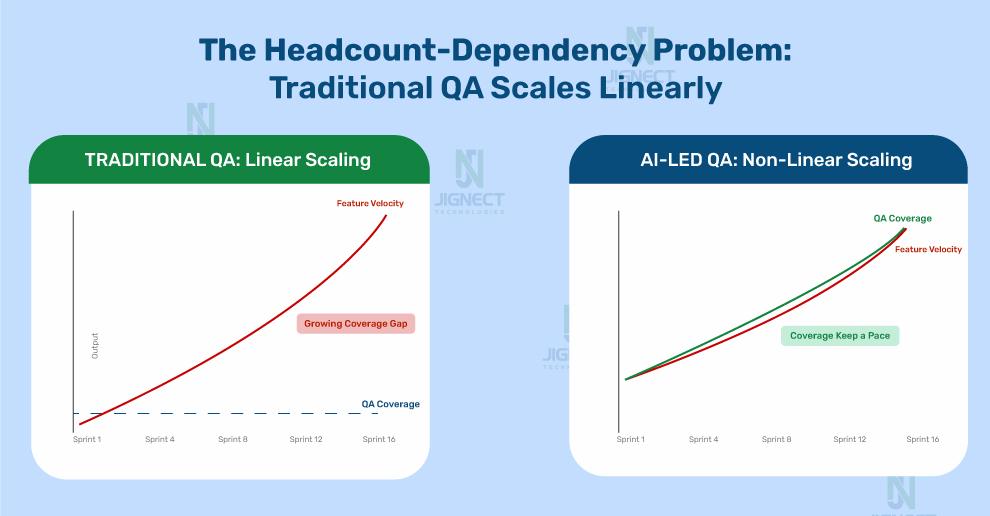
The fourth bottleneck is the accumulation of the first three. When test creation is slow, maintenance consumes a rising share of capacity, and triage absorbs several hours after every CI run, the net result is a coverage gap that widens with every sprint. New features ship with less testing than they should have. Edge cases and boundary conditions get deferred. The gap between what the test suite covers and what the application actually does grows, silently, until a defect surfaces in production that nobody can say was actually tested.
This gap is not a failure of QA engineering judgment. The QA engineers know what needs to be tested. The gap exists because the available capacity, after maintenance and triage are accounted for, is not sufficient to keep up with the rate at which new coverage is needed. Adding headcount makes the gap smaller temporarily. It does not close the gap structurally, because the next acceleration in development velocity, and there is always a next one, opens it again.
3. Scaling Is a Model Change, Not a Volume Change
The most important thing to understand about scaling QA with AI is that it is not primarily a technology question. It is a structural question. The technology is available and accessible. What separates the 15% who have scaled from the 72% who are still experimenting is that the 15% changed the model, not just the tools.
A model change means identifying which parts of the QA function should be done by AI entirely, which parts should be AI-assisted with human review, and which parts require exclusively human judgment. It means redesigning the workflow around those answers rather than adding AI tools to the existing workflow.
| AI as a feature: what stays the same | AI as the model: what changes |
| Workflow is identical to traditional QA. AI tools are used occasionally to speed up individual tasks. Test creation is still primarily manual. Maintenance is still handled by engineers. Triage is still manual investigation. Coverage scales linearly with headcount. | Mechanical work is removed from the human workflow. Test creation is AI-generated and human-reviewed. Maintenance is AI-assisted. Triage is AI-clustered. Coverage scales with the product, not the team. Engineers focus on design, judgment, and strategy. |
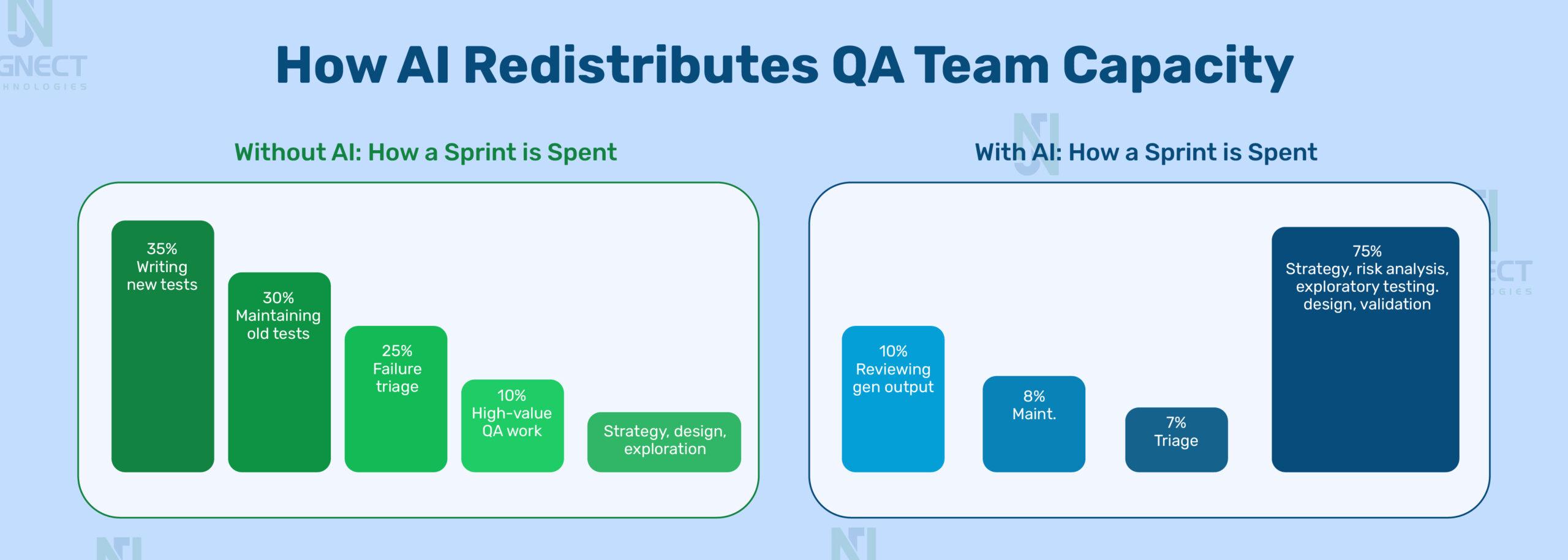
When AI is embedded as the model rather than added as a feature, the economics of the QA function change fundamentally. A QA engineer who previously spent sixty percent of their time writing test code and twenty percent maintaining it now spends twenty percent reviewing AI-generated code and sixty percent on the higher-judgment work: test design, risk assessment, exploratory testing, coverage planning, and quality analysis that actually requires human expertise. The team does not get smaller. It gets dramatically more effective per person.
This is what it means to scale without scaling. The headcount stays the same. The capacity, measured in coverage produced, features validated, defects caught, and quality signal generated, grows with the product.
4. The Six AI-Driven Levers That Replace Headcount
Scaling QA without scaling teams requires working across six specific capability areas simultaneously. Each one addresses a different bottleneck. Together they restructure the QA workflow from headcount-dependent to capability-dependent.
4.1 AI-Assisted Test Generation: From Hours to Minutes
The most direct lever is AI-generated test code. Using AI code editors like Cursor, Claude Code, and GitHub Copilot, a QA engineer can generate a complete test suite from acceptance criteria in minutes rather than hours. A Page Object class, the corresponding test spec, the test data factory, and the API integration tests for a new feature can be produced in a single Composer session with the right prompt and framework context. The engineer then spends twenty to thirty minutes validating the output against the real application, adding domain-specific scenarios the AI could not derive from the requirements, and reviewing every assertion for correctness. Total time for comprehensive test coverage: one to two hours instead of a full day.
The productivity difference compounds across a sprint. A QA engineer operating with AI assistance can cover three to four times the feature surface of a QA engineer working manually. That is not because they are working harder. It is because they have removed the translation layer between knowing what to test and having the test written. The thinking and the judgment remain human. The typing and the structuring belong to the AI.
| Scenario 1: AI-Assisted Test Generation E-Commerce / Checkout Redesign |
| Context | A QA team of three engineers supporting an e-commerce platform. The product team has delivered a full checkout flow redesign touching eight screens: cart review, address entry, address validation, shipping options, payment selection, order summary, payment processing, and order confirmation. Release window is one sprint. |
| Challenge | Writing thorough test coverage for eight interconnected screens manually would consume three of the sprint’s five working days just for test creation, leaving only two days for execution, defect reporting, and regression. In previous sprints, this bottleneck meant edge cases and boundary conditions were consistently deferred. Three sprints earlier, a boundary condition in the payment selection screen that was deferred reached production and caused a 2.4% cart abandonment spike before it was caught. |
| Solution | On Monday morning, each engineer takes responsibility for two to three screens and writes a structured prompt for each, encoding the acceptance criteria, the Playwright TypeScript framework conventions in use, the data-testid selector strategy, and the specific scenario types needed including negative paths, boundary values, and integration edge cases. The AI generates draft Page Objects and test specs for all eight screens by midday. Each engineer spends the afternoon validating locators against the actual DOM, confirming assertion text matches what the application displays, and adding domain-specific scenarios the AI could not derive from the requirements: specifically the payment gateway’s documented behaviour when a card is declined mid-authorisation, which sits in the team’s knowledge base but not in the acceptance criteria. |
| Outcome | The full suite is committed by Tuesday afternoon. Three days of writing compressed into one, with the remaining three days freed for deep exploratory testing of the redesigned flow and a full regression run. Test coverage across all eight screens is comprehensive, including the boundary conditions that were deferred in previous sprints. No deferred edge cases. No coverage gaps reaching the release candidate. |
4.2 Intelligent Test Prioritisation: Run Less, Cover More
A QA team trying to scale without additional headcount cannot afford to run every test on every commit. Intelligent test prioritisation uses code change analysis, defect history, component dependency mapping, and historical failure patterns to select the subset of the test suite most likely to catch a regression in a specific build. A change to the authentication module triggers the authentication test suite and the session management tests, not the full regression suite of five thousand tests.
This is not a new idea in principle. Risk-based testing has been a best practice in QA for years. What AI adds is the ability to execute it dynamically and accurately at scale. Instead of a manually maintained risk matrix that becomes outdated as the codebase evolves, an AI system analyses every commit and produces a prioritised test selection that reflects the actual risk profile of the change in real time. This means CI/CD pipelines get faster feedback without sacrificing meaningful coverage, and the QA team gets the same quality signal in a fraction of the execution time.
| Scenario 2: Intelligent Test Prioritisation SaaS Platform / Daily Release Cadence |
| Context | A B2B SaaS company with a team of five QA engineers supporting a platform that ships code twice daily. The full regression suite contains 5,200 tests and takes 92 minutes to run end to end. |
| Challenge | Running the full suite on every commit means six hours of pipeline execution time per day, creating a feedback queue that delays developer action on failures by three to four hours. Teams skip full suite runs to hit deployment windows, running only a manually-maintained smoke suite of 180 tests that consistently misses regressions in lower-risk modules. In one quarter, four production incidents were traced back to changes that passed the smoke suite but would have been caught by the full regression suite if it had been run. |
| Solution | The team integrates AI-driven test selection into the CI/CD pipeline. On each commit, the pipeline provides the diff of changed files to the AI selection layer, which maps changes against the component dependency graph and historical failure data to identify the subset of tests most likely to detect a regression. A commit touching the billing module triggers the billing suite, invoice generation tests, payment webhook integration tests, and the downstream reporting tests that depend on billing state: 340 tests in total. The full 5,200-test suite still runs on every nightly build, but intraday feedback comes from the targeted selection. |
| Outcome | The targeted selection runs in 11 minutes instead of 92, giving developers feedback within a single deployment window. Pipeline queue time drops from six hours to under 90 minutes per day. Over the following quarter, the four categories of production incidents that previously slipped through the smoke suite are caught in the targeted selection runs because the AI selection correctly identifies the dependency paths the manual smoke suite had not modelled. |
We explored how this approach connects to broader test coverage strategy in our blog on how to improve automation test coverage without increasing execution time, which covers the methods that make large suites faster without sacrificing the coverage that matters.
4.3 Self-Healing and AI-Assisted Maintenance
Maintenance is the bottleneck that kills scaling. Every test added to the suite adds to the maintenance obligation. Without a structural change in how maintenance works, the team eventually reaches a point where maintenance work fully consumes new coverage capacity, and the suite stops growing.
AI addresses this at both ends. Proactively, AI code editors generate more resilient locators from the start: getByRole() and getByTestId() selectors that survive UI refactoring, rather than CSS class selectors that break every time a developer updates the stylesheet. This alone reduces the maintenance burden significantly, because fewer tests break when the UI changes.
Reactively, when locators do break, AI analysis of the error, the old selector, and the new HTML produces a corrected selector and a more resilient alternative in minutes rather than the hour-long DOM investigation and manual fix cycle that traditional maintenance requires. Across a suite of any significant size, this compression of reactive maintenance time is substantial: what used to take a full day of maintenance work after a significant UI refactor takes an afternoon.
| Scenario 3: AI-Assisted Maintenance Product Redesign / 1,200-Test Suite |
| Context | A product company with a QA team of four engineers and an automation suite of 1,200 Playwright tests. The engineering team ships a major visual redesign: components are migrated from a custom library to a standardised design system, CSS class names are restructured, and several form layouts are reorganised. The redesign touches approximately 40 screens. |
| Challenge | The post-deployment CI run returns 380 test failures. None of them indicate broken functionality. All of them indicate broken locators: selectors targeting the old class names, custom component attributes, and form structure that no longer exist in the new design system. At the team’s previous pace of manually inspecting each failure, opening DevTools, finding the element, updating the selector, and re-running to confirm, each fix takes an average of five minutes. 380 fixes represent over 31 hours of maintenance work, consuming the entire team’s capacity for the better part of a week before any genuine defect investigation can begin. |
| Solution | The team groups the 380 failures by the type of structural change involved. For each group, one engineer pastes the error message, the failing selector, and the relevant section of the new component HTML into Claude Code with a prompt asking for a corrected locator and a more resilient alternative. The AI reads the structural change, identifies that the custom button class has been replaced by a role-based design system component, and suggests both the corrected selector (getByRole('button', { name: 'Proceed' })) and the reason the original was fragile. Working through clusters of structurally-identical failures this way, a single engineer handles 60 to 80 fixes per hour rather than 12. The remaining three engineers handle the groups in parallel. |
| Outcome | The 380 locator fixes are completed in four hours instead of 31. The team is back to defect investigation by midday rather than the following Thursday. The AI-suggested replacements are uniformly more resilient than the originals: subsequent UI iterations in that quarter break zero of the updated selectors, compared to a historical average of 60 to 80 breakages per significant UI change. Maintenance burden for future redesigns drops measurably because the suite architecture improves with each AI-assisted fix cycle. |
4.4 Automated Failure Triage at Scale
Intelligent failure triage is one of the highest-leverage capabilities in the AI-led QA toolkit, precisely because it compounds with pipeline frequency. Every additional CI run that happens per day adds another triage event that, in a traditional QA workflow, requires manual investigation. At two CI runs per day, five days per week, the manual triage burden across a quarter is enormous.
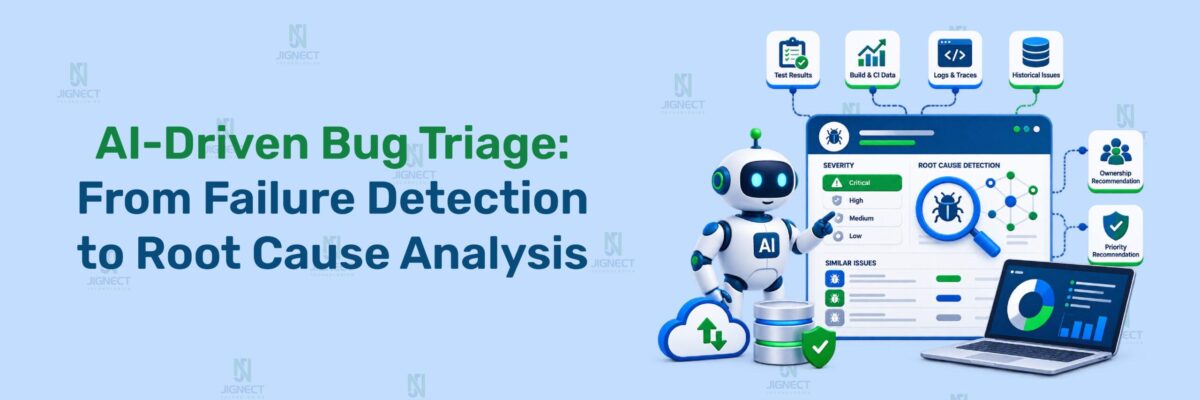
AI analysis clusters failures by root cause, identifies the code changes most likely responsible, distinguishes genuine defects from environmental noise, and produces a prioritised list of failures requiring human attention. What used to require four to six hours of investigation takes forty minutes. The QA engineer spends their time on the twelve genuine defects rather than the three hundred failures.
| Scenario 4: Automated Failure Triage Fintech / Overnight CI Failure Spike |
| Context | A fintech company with a QA team of six engineers running a full regression suite overnight as part of a CI/CD pipeline that also includes a scheduled infrastructure maintenance window. The suite contains 3,800 tests and typically returns 10 to 20 failures per night, all of which are investigated before the morning standup. |
| Challenge | After an overnight run coinciding with infrastructure maintenance, the pipeline returns 340 failures. The QA lead’s options are to investigate each failure manually, which would take most of the day and delay the morning’s planned release by at least five hours, or to make a judgment call about which failures are likely environment-related and release anyway, which carries risk. In previous incidents of this type, manually investigating 200-plus failures took two engineers a full working day, blocking all other QA activity and delaying a release that turned out to have no genuine defects at all. |
| Solution | The QA lead feeds the 340 failure logs, stack traces, and the overnight commit diff into Claude Code with a prompt asking for root cause clustering and defect classification. Within minutes, the analysis returns four clearly-labelled groups: 274 failures sharing a root cause in a database connection pool configuration change applied during the maintenance window; 41 failures tied to a breaking change in an internal API endpoint where the response schema was updated without a version bump; 14 pre-existing flaky tests that appear in the failure history at least once per fortnight; and 11 failures presenting as new defects introduced in the previous day’s feature work. Each cluster includes the specific error pattern, the most likely responsible commit, and a recommended action. |
| Outcome | Triage is complete in 35 minutes. The 274 environment failures are flagged to DevOps with the configuration change identified as root cause, confirmed and reverted before 9:30am. The 41 API failures are routed to the developer who updated the schema. The 11 genuine defects are opened as tickets with reproduction steps attached. The 14 flaky tests are logged in the test debt register. The planned release proceeds on schedule. The QA team’s morning is spent on defect investigation and a planned exploratory session rather than log reading, which would have consumed the full day in a manual triage workflow. |
4.5 AI-Powered Test Data Generation
Test data is an underappreciated constraint on QA scaling. Creating realistic, diverse, security-aware test data manually is slow, and the manual process is structurally biased toward the scenarios that are easiest to think of: the happy path, one or two obvious error cases, rather than the full matrix of boundary values, locale variants, and attack vectors that comprehensive testing requires.
AI generates the full matrix immediately. Valid users, invalid emails across a dozen failure modes, passwords that fail each individual requirement, boundary length values, locale-specific names with Unicode characters, SQL injection and XSS variants in input fields: all of this comes out of a structured prompt in seconds rather than requiring manual construction over hours. The QA engineer shifts from data author to data reviewer, which takes a fraction of the time and produces substantially better coverage.
| Scenario 5: AI-Powered Test Data Generation Healthcare SaaS / Multi-Region Launch |
| Context | A healthcare SaaS platform expanding from two to five markets, adding Germany, Japan, and the UAE. The QA team of four needs to validate the registration and onboarding flow against each new region’s data formats, character sets, address structures, and regulatory field requirements, including comprehensive invalid data, boundary value, and security testing for each locale. |
| Challenge | Constructing a representative test data set for three new locales manually requires researching valid date format conventions per region, sourcing realistic names in Japanese script with correct character encoding, building Arabic-script address data structured for UAE postal conventions, generating locale-appropriate SQL injection and XSS variants for each input field, and correctly modelling the boundary conditions for name, address, and identifier fields specific to each market’s validation rules. A QA engineer completing this manually produces a dataset in roughly six hours, but previous multi-region launches revealed that manually-constructed datasets consistently miss locale-specific boundary cases. The German launch two years earlier shipped with a date field that accepted an invalid format for German locale, surfacing in user reports within 48 hours of go-live. |
| Solution | The QA engineer writes a structured prompt specifying the three target locales, the field types requiring coverage, the scenario categories needed (valid profiles, invalid email variants, invalid password variants, SQL injection attempts, XSS attempts, boundary length values), and the known validation rules for each field. The AI generates a complete, structured TypeScript test data factory for all three regions in under three minutes. The engineer reviews the output against the product’s field validation specification document, identifies two entries where the AI used slightly incorrect date format conventions for German locale (DD.MM.YYYY rather than the application’s specific DD/MM/YYYY variant), corrects them, and confirms the Japanese Unicode name entries against the character set requirements documented in the product spec. |
| Outcome | A complete, review-validated test data set for all three regions is ready in 25 minutes instead of six hours. Coverage includes scenario categories that the manual approach consistently missed: boundary-length names in Japanese script, Arabic-script address fields at maximum length, and locale-specific SQL injection variants. All three regional launches pass QA validation with no locale-specific defects surfacing post-deployment. The German date format error that occurred in the previous launch is caught during validation against the spec, before a single test runs. |
4.6 Shift-Left Coverage: Quality Before the Sprint Ends
The final lever changes when in the delivery cycle QA coverage exists. In traditional QA, test design begins after development delivers a feature. In an AI-led QA function, test design begins during sprint planning, from the requirements themselves, before a line of implementation code is written.
AI analysis of acceptance criteria produces a coverage map: the scenario types that need testing, the boundary conditions the requirements imply, the edge cases that domain knowledge suggests are high-risk, and the integration points where components interact in ways that create compounded failure probability. This coverage map exists before development begins. When the feature is delivered, the test design is substantially complete. The QA engineer’s job is to validate and extend, not to start from scratch.
This is what shift-left testing actually looks like when AI is genuinely embedded in the workflow. Not just writing tests earlier, but designing coverage from requirements so that the test creation work runs in parallel with development rather than sequentially after it. The sprint does not expand. The QA work inside the sprint becomes dramatically more productive because the design phase is compressed by AI and the coding phase is compressed by AI code editors.
| Scenario 6: Shift-Left AI Coverage Planning Product Team / Notification Preferences Feature |
| Context | A product team building a notifications preferences feature: users can configure which event types trigger email, SMS, or push notifications, with frequency controls and quiet hour settings. The acceptance criteria run to twelve bullet points. Development estimates Thursday delivery. The QA team has a single engineer assigned to this feature. |
| Challenge | In the team’s traditional workflow, the QA engineer begins test design only after development delivers the feature. This means test design, script writing, and execution all happen in the last two days of the sprint, under time pressure. Edge cases that require clarification from the product owner get raised late, when the cost of changing implementation is highest. In the previous sprint, a notification feature shipped with an undefined behaviour for conflicting settings (email enabled, all notifications muted globally) that reached production and generated a support backlog of 34 tickets in the first week. |
| Solution | On Monday morning, the QA engineer feeds the twelve acceptance criteria bullet points into Claude Code with a prompt requesting a complete test coverage analysis: scenario types, boundary conditions implied by the requirements, high-risk edge cases given the nature of notification preferences, and integration scenarios between the preferences UI and the notification delivery pipeline. The analysis is complete in minutes and returns a structured coverage map: 26 test scenarios across six categories. It flags two gaps the acceptance criteria do not address: what happens when a user sets quiet hours that span midnight (does the system interpret this as the same calendar day or a cross-day window?) and what the expected API contract is when conflicting settings are saved simultaneously. The QA engineer shares the coverage map with the developer and product owner on Monday morning, before implementation begins. |
| Outcome | The midnight-spanning quiet hours case is confirmed as needing explicit handling, and the product owner defines the expected behaviour on Monday afternoon. The API conflict scenario is added to the developer’s implementation scope on Tuesday, before a single line of code that would have handled it incorrectly was written. By Thursday when development delivers, the QA engineer already has a complete test design and a partially-written suite. The feature is fully covered and committed by Friday. The type of undefined-behaviour defect that generated 34 support tickets in the previous sprint does not reach production because the ambiguity was surfaced at the cheapest possible point in the delivery cycle: before implementation began. |
5. What Scaled QA Actually Looks Like in Practice
Abstract principles are useful. Concrete pictures of what scaled QA looks like in operation are more useful. Here is what a typical sprint looks like for a QA team that has restructured around AI assistance versus one that has not.
| Sprint Activity | Traditional QA Team | AI-Led QA Team (Same Size) |
| Sprint planning | QA reviews stories, plans test approach manually, estimates test effort | AI analyses ACs and produces a coverage map with scenario types and risk flags; QE reviews and refines in 30 minutes |
| Test creation | 2-3 days per feature: POM, spec, test data all written manually | 30-90 min per feature: AI generates, QE reviews, extends with domain cases |
| API test coverage | Manual scripting from spec; often deferred when time is short | API Testing Studio generates from spec in minutes; QE validates responses |
| CI failure response | 4-6 hrs manual triage per run; engineers read every stack trace | 40 min AI clustering; engineers address genuine defects only |
| Locator maintenance | Full day after major UI refactor; each broken test investigated manually | AI suggests fixes; engineer approves; afternoon instead of a day |
| Test data | Written manually; happy path and obvious errors; edge cases often missed | AI generates full matrix including boundary, security, and locale variants |
| Bug reporting | QE writes report manually; back-and-forth with developer to reproduce | Bug Genius captures one-click; developer has everything to reproduce immediately |
| Accessibility checks | Separate manual WCAG audit; documentation written from scratch | Accessibility Genius runs one-click scan; findings ranked; report auto-generated |
| Coverage per sprint | 2-3 features fully covered; remainder deferred | 5-8 features fully covered; same team, same sprint |
The same team size. The same sprint length. Two to three times the coverage output. That difference does not come from working harder. It comes from removing the mechanical work from the human workload entirely and redirecting that time toward the work that actually requires human expertise.
6. The Metrics That Show You Are Scaling, Not Just Busy
Scaling QA without scaling teams requires a different set of metrics than traditional QA uses. If you are measuring the same things you measured before, you will not see the improvement, because the improvement is not in the traditional metrics. It is in the relationship between inputs and outputs.
The metrics that actually tell you whether AI-led QA is working:
Coverage velocity: The ratio of new test coverage added per sprint to QA team size. In a traditionally-scaled team, this ratio stays roughly constant as you add people. In an AI-led team, this ratio increases over time as the AI workflow matures, without adding headcount.
Defect escape rate: The percentage of defects that reach production without being caught in QA. This is the metric that shows whether scaling is actually working or whether you are covering more ground with the same quality signal. A scaling approach that improves coverage velocity but does not reduce defect escape rate is covering more ground less carefully, not scaling.
Time from requirement to coverage: How long between a feature being specified and that feature having test coverage. In an AI-led workflow with shift-left design, this gap should compress toward zero: coverage design begins at planning, coverage code is ready when development delivers the feature. In a traditional workflow, this gap is measured in days or weeks.
Maintenance cost as a percentage of QA capacity: The fraction of a QA engineer’s sprint that goes to keeping existing tests running versus creating new coverage. This is the metric that shows whether the maintenance treadmill is under control. A well-functioning AI-led QA team should see this ratio drop significantly over the first few sprints of AI adoption and continue declining as the test suite matures.
Mean time to root cause: How long from CI failure to identified root cause. The difference between four hours and forty minutes, compounded across a pipeline running twice daily, represents days of recovered QA capacity per month.
We have explored the connection between meaningful QA metrics and the ROI of automated testing in detail. The same logic applies to AI-led scaling: the metrics that matter are the ones that connect QA activity to business outcomes, not the ones that measure activity for its own sake.
7. The Three Phases of the Scaling Journey
Organisations that successfully scale QA without scaling teams follow a recognisable progression. Understanding the phases helps set realistic expectations and avoid the most common mistake: trying to achieve the outcomes of phase three without doing the foundation work of phases one and two.
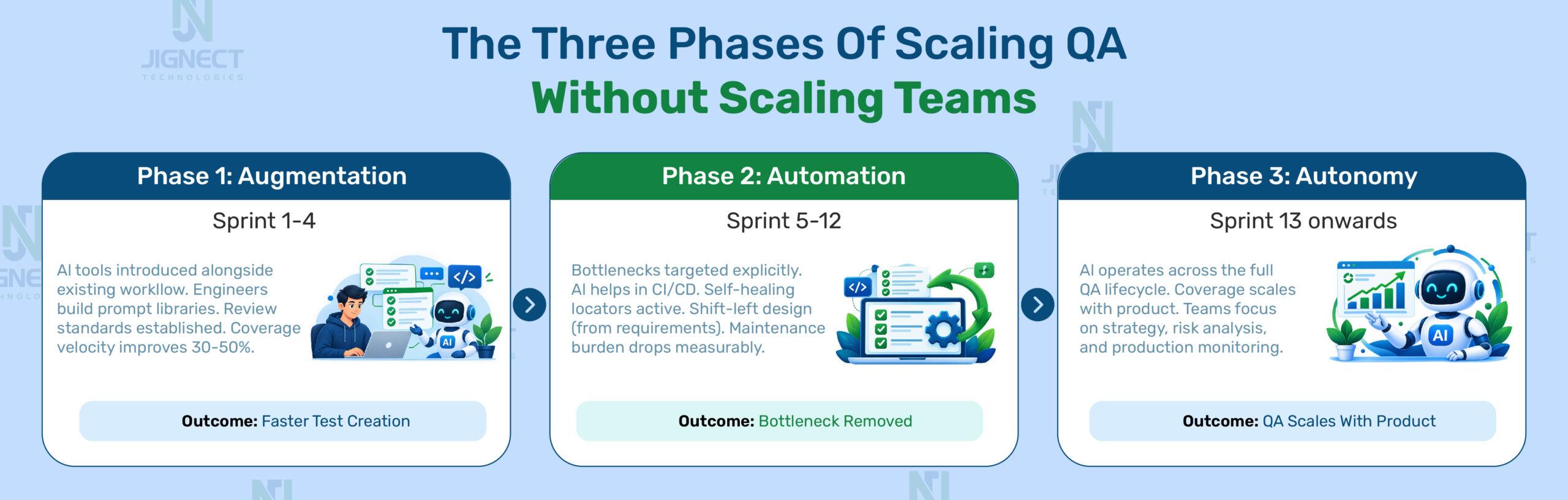
Phase 1: Augmentation. AI tools are introduced alongside the existing workflow. Engineers learn to write effective prompts. A shared prompt library is started. Review standards for AI-generated output are established. The test creation speed improves significantly, typically 30 to 50 percent faster per feature. Coverage velocity improves. This phase builds the team’s confidence in AI output and establishes the governance structures that make phase 2 possible.
Phase 2: Automation of bottlenecks. The highest-cost bottlenecks are targeted explicitly. AI triage is integrated into the CI/CD pipeline. Self-healing locator capabilities are active. Shift-left design from requirements is established as standard practice. Maintenance burden drops measurably. The team starts to see coverage velocity improve not just in speed but in depth: more scenario types covered per feature, more boundary cases, more security inputs. This phase is where the model change becomes visible in the metrics.
Phase 3: Autonomy at scale. AI operates across the full QA lifecycle. Coverage scales with the product rather than the team. Engineers spend the majority of their time on the work that requires their expertise: risk analysis, exploratory testing, AI/ML model validation, production monitoring, and quality strategy. The QA function is no longer a bottleneck in the delivery pipeline. It is a quality intelligence capability that gives engineering leadership the signal they need to make informed release decisions.
Most organisations that stall do so in the transition from phase 1 to phase 2. They have adopted AI tools for test generation and seen the productivity improvement, but they have not addressed the maintenance and triage bottlenecks that continue to consume QA capacity. The gains from faster test creation get absorbed by the maintenance and triage work that still runs manually. To get from phase 1 to phase 2, the bottleneck removal has to be intentional and structural, not incremental.
8. What Prevents Teams From Scaling (And How to Avoid Each Trap)
The “AI as accelerator” trap. Using AI to do the same work faster is not scaling. If the workflow is identical to what it was before and AI is simply compressing the time each step takes, the coverage ceiling is lower than it could be and the maintenance bottleneck will reassert itself as the suite grows. The fix: identify which steps should be removed from the human workflow entirely rather than just made faster.
The prompt quality trap. AI-generated test output quality tracks prompt quality almost perfectly. Teams that use generic, under-specified prompts get generic, under-specified tests that require significant rework. The rework cost erodes the productivity gain. The fix: invest in prompt development as a first-class engineering activity. Build a shared prompt library that encodes what works. Use Orkestraa’s Prompt Studio to govern and version that library so it improves over time rather than staying static.
The review-skipping trap. AI-generated tests can look comprehensive while testing the wrong thing. An assertion that checks whether a message is visible rather than whether its content is correct passes every time but catches nothing. Teams that accept AI output without rigorous review accumulate false confidence. The fix: establish a clear review standard that asks, for every AI-generated assertion, whether this test actually fails when the feature is broken. That question requires human domain knowledge and cannot be automated away.
The tools-not-workflow trap. Adding AI tools to the team’s toolkit without changing the workflow produces marginal gains. The tools work; the workflow is still the bottleneck. The fix: redesign the workflow first, then select the tools that serve the redesigned workflow. AI tools embedded in a well-designed workflow produce dramatically better outcomes than AI tools added to a poorly-designed one.
The metrics-unchanged trap. Measuring the AI-led QA function by traditional metrics, test cases run, pass rate, defect count, does not capture the scaling gains and creates perverse incentives. A team that is generating more meaningful coverage with AI might produce fewer test cases than a team writing large numbers of low-value manual tests. The fix: adopt the metrics described in section 6 that measure the relationship between input and output rather than output alone.
9. How JigNect Helps Organisations Scale QA Without Adding Headcount
JigNect has been building the methodology and the toolchain for AI-led QA scaling across our engagements over the past several years. The position we documented in Automation Is No Longer Enough: Welcome to AI-Driven Quality Engineering is not a theoretical framing. It reflects how our teams work on active client engagements and what we have observed produces durable scaling gains versus what produces short-term productivity improvements that plateau.
Our automation testing practice is built around AI-assisted test generation as the standard, not the exception. AI code editors, governed prompt libraries, and structured human review processes are how our engineers build coverage, not a supplementary tool they reach for when manual work becomes too slow. The difference in coverage velocity is visible from the first sprint.
The AIdriventesting.ai platform, our suite of AI-powered QA utilities, is the practical layer we use alongside AI code editors in our daily delivery work. It handles the specific tasks that remain bottlenecks even after the generation and triage workflows are AI-assisted: browser-level bug capture with full context in one click, AI-powered accessibility compliance scanning, test data generation directly in the browser, and CI report generation without manual formatting. These tools are not the centrepiece of the scaling approach. They are the last-mile utilities that remove the remaining pockets of mechanical work from an otherwise AI-led workflow.
For organisations at the beginning of this journey, our engagement starts with an honest audit: where are the bottlenecks in the current QA workflow, how much capacity is being consumed by mechanical work versus judgment-intensive work, and what would the coverage velocity look like if the mechanical work were removed. The answer to those questions defines a concrete, phased scaling plan rather than a generic AI adoption roadmap.
For organisations further along who need to break through a scaling plateau, we focus on the phase 2 work that produces the largest gains: CI-integrated failure triage, shift-left coverage design from requirements, self-healing maintenance architecture, and the prompt library governance that makes AI assistance systematic rather than individual. The journey from automation-first to AI-first quality engineering we have documented reflects the same phases we help client teams navigate.
If your organisation is experiencing the coverage gap, the maintenance treadmill, or the failure triage bottleneck described in this blog, the most useful starting point is a conversation about your specific situation rather than a generic capability presentation. Get in touch and we can start with an assessment of where the scaling constraints actually sit in your current QA function.
Is your QA team the bottleneck in your delivery pipeline?
JigNect can assess where the scaling constraints are in your current QA function and show you what coverage velocity looks like when AI absorbs the mechanical work.
10. Closing Thoughts
The question of how to scale QA without scaling teams is really a question about what QA actually requires human expertise for. When you answer that question honestly, it becomes clear that most of what consumes QA engineering time in a traditional workflow does not require the kind of expertise QA engineers have. It requires patience and attention to detail, which AI provides at a fraction of the cost and without fatigue.
What genuinely requires human expertise: understanding what is worth testing, designing coverage that reflects the real risk profile of the system, doing the exploratory thinking that finds failure modes nobody anticipated, validating that AI-generated tests are actually testing what they claim to, and connecting quality signal to the decisions that engineering leadership needs to make. That work is not going away. It is becoming more important as the product becomes more complex and the delivery pace increases.
Scaling QA without scaling teams means directing more of your QA team’s expertise toward that high-judgment work, by removing the mechanical work that currently crowds it out. The teams that figure this out are not the ones with the largest QA budgets or the most engineers. They are the ones with the clearest thinking about what their QA function is actually for, and the most deliberate approach to embedding AI in the workflow rather than adding it to the edges.
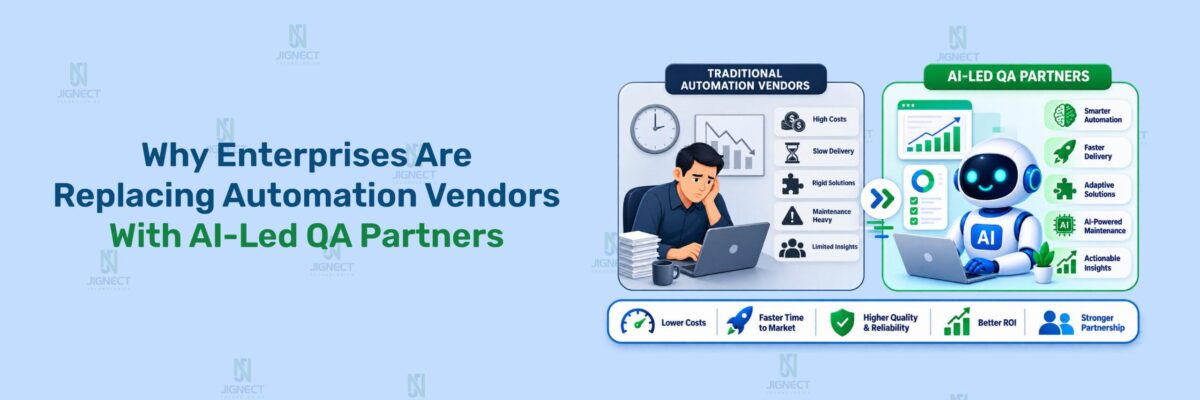
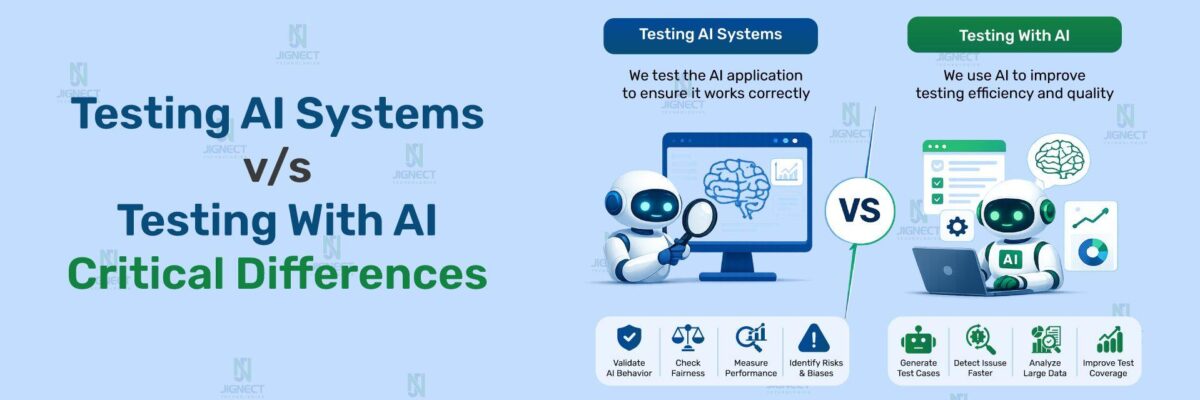
For further reading on the strategic and technical dimensions of this shift, the blogs on testing AI systems versus testing with AI, on the top challenges in AI-based testing, and on why enterprises are replacing automation vendors with AI-led QA partners cover the surrounding terrain in detail.
Witness how our meticulous approach and cutting-edge solutions have elevated quality and performance to new heights. To know more, refer to Tools and Technologies and QA Services.
If you would like to learn more about the services we provide, be sure to reach out.
Happy Testing 😊