// The Ultimate Guide to Testing Large-Scale IoT Systems: Strategies, Challenges & Best Practices
The Internet of Things (IoT) is expanding at an extraordinary pace, powering everything from smart home devices to industrial automation and connected vehicles. As these ecosystems grow in scale and complexity, ensuring their reliability, performance, and security becomes a major engineering challenge. This blog provides a comprehensive guide to testing large-scale IoT applications, covering foundational concepts, real-world challenges, essential testing types, automation strategies, and future trends. Whether you’re new to IoT or looking to refine an enterprise-level testing approach, this detailed overview will help you build robust, scalable, and future-ready IoT systems.
What Is IoT?
IoT (Internet of Things) refers to a vast network of physical devices embedded with sensors, software, and connectivity that enables them to collect, exchange, and act on data over the internet or other communication networks - without direct human intervention.
These devices range from consumer gadgets, such as smart thermostats and fitness trackers, to industrial equipment, including smart meters, connected machinery, and autonomous vehicles.
Key Characteristics of IoT:
- Connectivity: Devices are connected via Wi-Fi, Bluetooth, Zigbee, LoRa, cellular, or Ethernet.
- Data Collection: Sensors gather real-time data from the environment (e.g., temperature, movement, pressure).
- Intelligence: Devices can analyze data locally (edge computing) or send it to the cloud for processing.
- Automation: Devices can trigger actions automatically - e.g., a smart lock opening via facial recognition.
Why Testing Matters in IoT Eco Systems?
The Internet of Things (IoT) connects billions of heterogeneous devices across networks, platforms, and environments - making it powerful, but also incredibly complex. In this diverse ecosystem, testing isn’t just recommended - it’s essential to ensure reliability, security, scalability, and user trust.
1. Diverse and Fragmented Ecosystem : This testing is crucial to ensure all components work seamlessly together and handle edge cases across different configurations.
2. Security Risks Are Higher Than Ever : This testing helps identify and mitigate these risks before they’re exploited in production.
3. Real-Time and Mission-Critical Operations : This testing ensures low latency, real-time responsiveness, and fail-safe mechanisms.
4. Scalability & Performance Under Massive Loads : Load testing and scalability testing simulate high-volume conditions to ensure the ecosystem holds up.
5. Continuous Software and Firmware Updates : This testing is necessary to ensure that updates do not break existing functionality, validate rollback mechanisms if updates fail, and maintain version compatibility across the ecosystem.
6. Regulatory and Compliance Requirements : Certain industries, such as health care, automotive, and financial services, call for strict compliance testing, like HIPAA, GDPR, ISO/IEC 27001, and FDA regulations.
7. Enhanced User Experience & Reliability
Improved User Experience & Reliability. Such comprehensive testing ensures that devices perform with reliability regarding the real-world conditions they were designed for.
Challenges of Large-Scale IoT Testing
Testing IoT applications is fundamentally more complex than testing traditional software systems. That is simply because of the nature of IoT, wherein devices, sensors, networks, cloud systems, and user interfaces come together, collocated in a highly distributed, heterogeneous ecosystem. These challenges scale when there are millions of devices. Organizations often partner with specialized QA teams to overcome these challenges efficiently. Learn how professional testing services can accelerate IoT quality: The following are the major challenges that occur in large-scale IoT testing:
1. Device Diversity and Hardware Dependencies
- IoT devices differ in hardware capabilities (processors, memory, battery, sensors).
- Testing on one device type does not guarantee the same results on another.
- Dependency on physical devices makes test setup, maintenance, and scalability harder.
- Continuous firmware updates further complicate test coverage.
2. Network Complexity and Real-World Conditions
- IoT devices communicate via multiple protocols (Wi-Fi, Zigbee, LoRa, Bluetooth, 5G).
- Ensuring compatibility across these networks is non-trivial.
- Real-world conditions- like unstable connectivity, high latency, jitter, and packet loss- are difficult to replicate in test labs.
3. Scalability & Performance Bottlenecks
- Simulating millions of devices transmitting data simultaneously is extremely resource-intensive.
- Bottlenecks can appear at gateways, cloud ingestion pipelines, or data processing layers.
- Performance degradation under heavy load may cause message delays, data loss, or unresponsive systems.
4. Real-Time Processing Constraints
- Many IoT systems (healthcare monitoring, autonomous vehicles, industrial control) require real-time decision-making.
- Even a small delay in processing or wrong sensor data can lead to catastrophic failures.
- Testing for such constraints at scale is highly complex.
5. Security Vulnerabilities
- Every IoT device is a potential entry point for cyberattacks.
- Weak authentication, insecure firmware updates, and unencrypted communication increase risks.
- Ensuring secure boot, OTA (Over-the-Air) update testing, penetration testing, and compliance validation at scale is challenging.
6. Power and Battery Optimization
- IoT devices often run on limited battery power.
- Frequent firmware updates, continuous network communication, or inefficient protocols may drain batteries quickly.
- Testing energy consumption across thousands of devices in real-world usage patterns is difficult.
7. Lack of Standardization in IoT Ecosystem
- Different vendors use different protocols, data formats, and device management systems.
- Lack of universal testing standards creates interoperability challenges.
- Custom testing frameworks are often required, leading to fragmented test environments.
8. OTA Updates & Firmware Rollbacks
- Updating device firmware over-the-air introduces risks like incomplete installations, bricked devices, or version conflicts.
- Rollback mechanisms must be tested extensively to ensure reliability.
- Scaling such update tests across millions of devices is error-prone and costly.
9. Environment Simulation Limitations
- IoT devices interact with the physical world (temperature, motion, light, pressure).
- Creating realistic simulations of environmental conditions is complex and expensive.
- Lab conditions often fail to fully replicate real-world scenarios.
10. Data Explosion & Validation
- IoT generates massive volumes of structured and unstructured data.
- Validating the correctness, completeness, and integrity of this data at scale is a huge challenge.
- Ensuring real-time analytics pipelines process data without loss or corruption adds another layer of difficulty.
Layers of IoT Architecture & Where Testing Applies
IoT systems are built on multiple layers, each with its own role and testing needs. Understanding these layers helps us design the right testing strategies for large-scale IoT applications.
Overview of IoT Layers
An IoT ecosystem is more than just connected devices. It involves sensors, networks, gateways, applications, and cloud platforms - all working together. Testing needs to happen at each layer to ensure end-to-end reliability, performance, and security.
Perception Layer (Device/Sensor Layer)
- Role: Collects data from the physical environment using sensors and actuators.
- Testing Focus:
- Hardware reliability and calibration
- Sensor accuracy under different conditions
- Battery performance and power consumption
Network Layer (Communication Layer)
- Role: Transfers data between devices, gateways, and the cloud using Wi-Fi, Bluetooth, Zigbee, LoRa, 5G, etc.
- Testing Focus:
- Connectivity stability under real-world conditions
- Network latency, jitter, and packet loss
- Failover and recovery during network outages
Edge Layer (Gateway / Fog Layer)
- Role: Performs local processing before sending data to the cloud, reducing latency and bandwidth usage.
- Testing Focus:
- Local decision-making and response times
- Data filtering, aggregation, and preprocessing
- Resilience during offline mode
Application Layer
- Role: Provides services to end-users via apps, dashboards, or APIs.
- Testing Focus:
- Usability and accessibility
- Functional testing of apps and APIs
- Compatibility across devices and platforms
Data Layer (Cloud / Storage Layer)
- Role: Stores, processes, and analyzes data in the cloud or big data platforms.
- Testing Focus:
- Data integrity and consistency
- Scalability for millions of events
- Performance of analytics and reporting
Security Layer (Cross-Cutting Layer)
- Role: Protects the entire IoT ecosystem across all layers.
- Testing Focus:
- Authentication and identity management
- Secure communication (encryption, certificates)
- Vulnerability and penetration testing
Types of IoT Testing
Testing in IoT applications must go beyond standard software checks because devices, networks, and cloud systems all work together. Below are the key types of IoT testing and where they apply:
Unit Testing (Device Firmware & Edge Logic)
- Purpose: Validate individual components like sensor firmware, microcontroller code, or edge logic.
- Example: Ensuring a temperature sensor’s firmware correctly captures and transmits readings.
Integration Testing (APIs & Cloud Pipelines)
- Purpose: Verify communication between different modules, devices, APIs, and cloud services.
- Example: Testing whether an IoT device sends data correctly to the cloud and APIs process it as expected.
System Testing (End-to-End Validation)
- Purpose: Validate the entire IoT ecosystem- device, network, edge, cloud, and application layers- work together seamlessly.
- Example: Checking that a smart lock responds instantly to commands sent from a mobile app.
Performance & Scalability Testing
- Purpose: Ensure the system can handle thousands or millions of devices and data streams simultaneously.
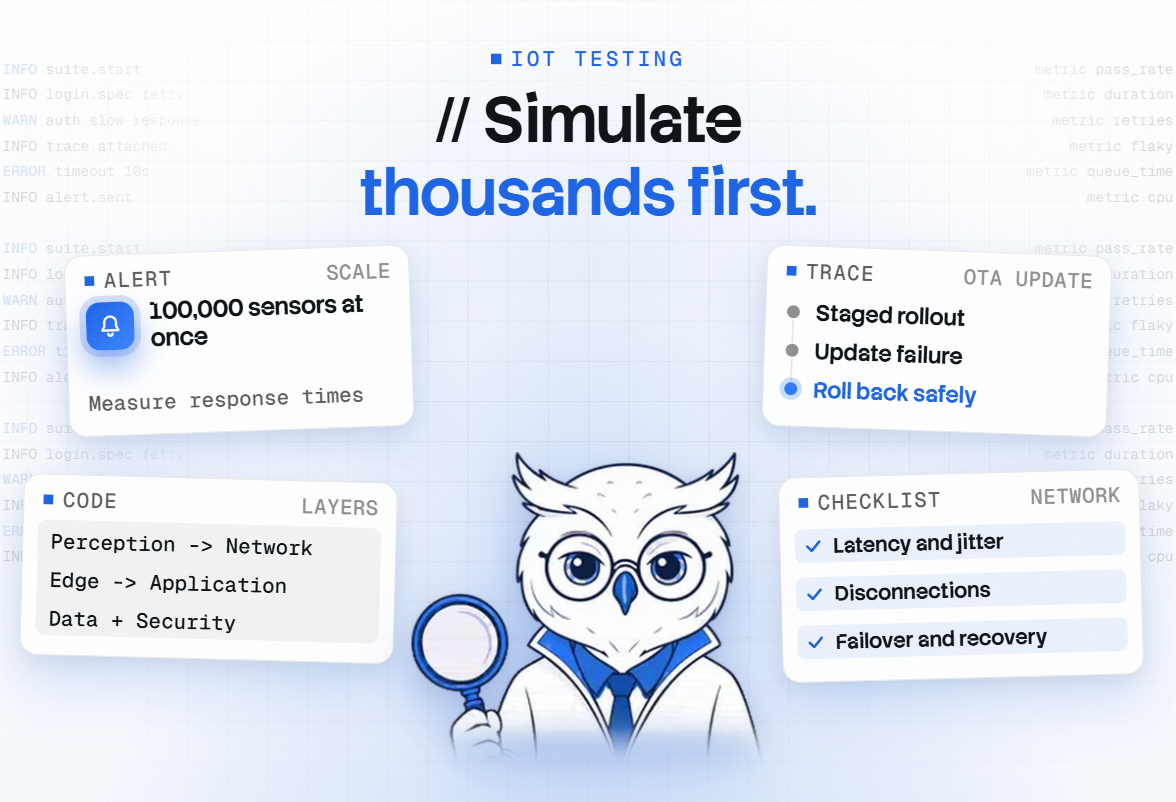
- Example: Measuring response times when 100,000 sensors push data at once.
Security Testing
- Purpose: Identify vulnerabilities across all layers to prevent cyberattacks and data breaches.
- Example: Testing encryption of data in transit between devices and cloud servers.
Interoperability Testing
- Purpose: Confirm devices and platforms from different vendors work together without issues.
- Example: Ensuring a Zigbee-based sensor works correctly with a Wi-Fi gateway.
Usability & Accessibility Testing
- Purpose: Validate that IoT applications are user-friendly and accessible to diverse users.
- Example: Checking if a smart home app is intuitive and accessible to visually impaired users.
Compliance & Regulatory Testing
- Purpose: Ensure the IoT system meets industry-specific standards and legal requirements.
- Examples:
- HIPAA: For healthcare IoT devices handling patient data.
- GDPR: For European Union data privacy compliance.
- ISO standards: For safety, quality, and interoperability.
Key Testing Strategies for Large-Scale IoT
Simulation & Virtualization
In large-scale IoT systems, testing with thousands of real devices is expensive, complex, and often not practical. This is where simulation and virtualization play an important role.
- Simulate thousands of virtual devices
Virtual devices can be created to mimic the behavior of real sensors and hardware. This helps teams test system performance, scalability, and data handling without needing a massive physical setup. - Use emulators for early-stage testing
During development, emulators allow developers to test device firmware, APIs, and communication flows before actual devices are available. This speeds up issue detection and reduces delays. - Reduce hardware dependency
By using simulations and emulators, testing can continue even when hardware is limited. This lowers costs, increases flexibility, and ensures faster test cycles.
Test Automation at Scale
Manual testing alone cannot keep up with the complexity and scale of IoT systems. With thousands of devices, multiple networks, and continuous data flows, automation becomes essential to ensure speed, consistency, and reliability.
Scope of Automation in IoT Systems
Automation in IoT is not limited to applications- it covers devices, networks, cloud services, and data pipelines. The main areas include:
- Automate API, firmware, and cloud testing
- APIs: Validate device-to-cloud and app-to-cloud communication.
- Firmware: Automate regression testing to ensure device stability after updates.
- Cloud: Test data ingestion, processing, and storage workflows.
- Data-Driven and Behavior-Driven Testing
- Data-Driven: Run the same test with different sensor values or user inputs.
- Behavior-Driven (BDD): Write tests in plain language (e.g., Cucumber) so developers, testers, and business teams share the same understanding.
- Tools for IoT Test Automation
A wide range of tools can be used depending on the testing layer:
- Selenium & Appium – UI and mobile app automation.
- Postman – API functional and regression testing.
- JMeter – Load and performance testing for large-scale IoT traffic.
- Robot Framework – Keyword-driven automation for IoT workflows.
- testRigor – AI-powered test automation with minimal scripting needs.
- Integrate Automation with CI/CD Pipelines
- Continuous Integration and Continuous Delivery (CI/CD) pipelines allow automated tests to run every time new code, firmware, or configuration is deployed.
- This ensures faster feedback, early bug detection, and reliable releases.
Edge vs Cloud Testing Approach
- Edge Testing: Validates local decision-making at the device or gateway level. Ensures actions (like shutting down a machine when overheating is detected) work instantly without cloud dependency.
- Cloud Testing: Focuses on validating large-scale data aggregation, analytics, dashboards, and integrations in the cloud.
Specialized Testing Scenarios
In IoT, not all testing can be handled with standard functional or performance checks. Some scenarios are unique to large-scale IoT environments and require specialized testing approaches.
Environment & Network Simulation
IoT devices often operate in unpredictable environments and over unreliable networks. Testing must account for these real-world challenges.
- Simulate latency, jitter, and disconnections – Recreate network delays, unstable bandwidth, or packet loss to see how devices respond.
- Test poor connectivity and failover behavior – Validate that devices can store data locally, reconnect automatically, and recover gracefully when the network returns.
Security-First Testing
Since IoT devices are common targets for cyberattacks, security testing must be prioritized across every layer.
- Penetration testing – Identify vulnerabilities in devices, APIs, and cloud systems.
- Secure OTA (Over-the-Air) updates – Ensure updates are encrypted and authenticated to prevent tampering.
- Identity management & secure boot – Verify that only trusted devices join the network and that systems start securely from the first boot.
OTA Updates & Firmware Testing
Firmware and software updates are critical for IoT devices, but also carry risks. A failed update could disable thousands of devices at once.
- Safe rollout and rollback strategy – Use phased deployments (like canary or staged rollouts) to limit the impact of faulty updates.
- Handle update failures and version conflicts – Ensure devices can retry updates, roll back safely, and remain functional even during failures.
Common Challenges in IoT Testing
Testing IoT systems is more complex than traditional software testing because it involves hardware, networks, cloud platforms, and real-world conditions. Below are some of the most common challenges teams face:
Hardware Dependencies and Diversity
IoT ecosystems include a wide variety of sensors, devices, and gateways from different vendors. Each has its own hardware specifications, firmware, and protocols. Testing across all possible combinations is time-consuming and often impractical without simulations.
Real-Time Constraints
Many IoT applications- like healthcare monitoring, industrial automation, or autonomous vehicles- require instant responses. Even a small delay can lead to serious failures. Testing for strict real-time requirements adds significant complexity.
Limited Standardization Across Environments
The IoT ecosystem lacks universal standards for communication, security, and testing. Different vendors use different protocols and data formats, which makes creating reusable and scalable test frameworks difficult.
Battery and Power Optimization
Most IoT devices are battery-powered and expected to run for long periods without charging. Testing must evaluate how devices handle power consumption under different workloads and connectivity conditions, which requires long-duration and resource-intensive testing.
OTA Firmware Complexity
Over-the-Air (OTA) updates are essential for fixing bugs and improving features. However, testing OTA updates is complex because:
- Devices may lose connection mid-update.
- Version conflicts can occur.
- Failed updates may render devices unusable ("bricking").
Limited Scalability with Real Hardware
Simulating millions of connected devices in real life is nearly impossible due to cost and logistics. Testing at scale with only physical hardware is restrictive, leading to gaps in scalability validation.
Best Practices for Effective IoT Testing
To handle the scale, complexity, and unpredictability of IoT systems, testing must follow a disciplined and forward-looking approach. Below are some best practices that help teams deliver reliable and secure IoT applications.
Shift-Left and Test Early
Catch issues as early as possible in the development cycle. Testing device firmware, APIs, and integrations during early stages reduces costly fixes later and ensures faster releases.
Modular and Maintainable Test Design
Design tests in a modular way so they can be reused across devices, networks, and cloud services. This reduces duplication, makes test suites easier to maintain, and improves scalability.
Continuous Testing and Monitoring
Integrate automated tests into CI/CD pipelines to validate every build, firmware update, or deployment. Pair this with continuous monitoring in production to detect performance issues, outages, or anomalies in real time.
Field Testing with Real-World Scenarios
While simulations are essential, real-world testing cannot be ignored. Deploy devices in actual environments (e.g., low-signal areas, industrial sites) to uncover issues that lab conditions may miss.
Canary Deployments and Telemetry Validation
Release updates gradually (canary deployments) to a small subset of devices before rolling out to the entire ecosystem. Combine this with telemetry data validation to ensure updates are safe and reliable.
Invest in Test Data and Flaky Test Isolation
Good test data is crucial for realistic validation. Build a strong test data management strategy and isolate flaky tests (those that fail intermittently) to avoid false alarms and wasted effort.
Feedback Loops from Production
Leverage production telemetry, logs, and user feedback to continuously improve test cases. This ensures tests remain relevant and aligned with how devices behave in the real world.
Real-World Example
Smart Homes
Smart home ecosystems (like connected lights, thermostats, and locks) rely on interoperability across multiple vendors.
- Challenges: Device compatibility, network reliability, and data privacy.
- Tools Used: Appium for mobile app control testing, Postman for API validation, and JMeter for load testing.
- What Worked: Simulation of multiple virtual devices in different network conditions to ensure stability before release.
Industrial IoT (IIoT)
Factories use IoT sensors for predictive maintenance and real-time monitoring.
- Challenges: Real-time constraints, massive data streams, and hardware dependencies.
- Tools Used: MQTT simulators for device traffic, Robot Framework for automation, and Grafana for telemetry monitoring.
- What Worked: Canary deployments in a limited production area to validate system performance before scaling factory-wide.
Connected Cars
Modern vehicles integrate IoT for navigation, safety, and infotainment.
- Challenges: Low latency requirements, OTA (Over-the-Air) updates, and safety-critical compliance.
- Tools Used: Emulators for vehicle systems, penetration testing tools for security, and specialized automotive test frameworks.
- What Worked: Secure OTA rollout with rollback strategies to prevent failures during updates.
Future Trends in IoT Testing
AI/ML in Test Automation
Machine Learning will help analyze test results, detect anomalies, and automatically suggest new test scenarios based on device behavior.
Self-Healing Tests
Automation frameworks will self-correct when facing flaky tests or environmental issues, reducing manual intervention.
5G and IoT Testing Impacts
With 5G, IoT systems will see ultra-low latency and massive device connectivity. Testing strategies will shift to validate performance at scale under high-speed, real-time conditions.
IoT Test-as-a-Service (TaaS)
Enterprises are increasingly outsourcing IoT testing to specialized providers who offer scalable device simulations, compliance validation, and cloud-based testing environments.
Conclusion
You’ve now explored the complete journey of testing large-scale IoT systems - from understanding their layered architecture to applying advanced automation and simulation strategies. With these practices, you can ensure that every connected device, gateway, and cloud component performs reliably, securely, and efficiently.
By implementing the testing approaches covered in this blog - including shift-left testing, CI/CD integration, and real-world validation - you build a foundation for scalable, high-quality IoT systems that stand up to the complexity of modern connectivity.
As IoT continues to grow across industries, combining automation, AI-driven analytics, and continuous monitoring will keep your systems future-ready and resilient. The key to success lies in testing early, testing smart, and testing continuously - turning complex IoT ecosystems into dependable, intelligent networks.
Keep innovating, keep testing - your IoT solutions are now built for the future of connectivity!
Witness how our meticulous approach and cutting-edge solutions elevated quality and performance to new heights. Begin your journey into the world of software testing excellence. To know more refer to Tools & Technologies & QA Services.
If you would like to learn more about the awesome services we provide, be sure to reach out.
Happy Testing 🙂