Large Enterprise IoT Platform: Overcoming the Hardware Gap with Automated Event Validation
Client Overview
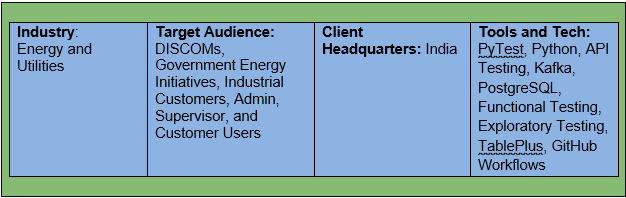
The client is a leading technology provider in the Energy and Utilities sector, delivering an IoT-enabled smart metering platform for DISCOMs, government energy initiatives, and industrial customers. The centralized web ecosystem supports real-time meter monitoring, remote command execution, energy analytics, and operational reporting through role-based access for Admin, Supervisor, and Customer users.
As the platform expanded to support a growing customer base and frequent feature releases, maintaining product quality, data accuracy, and release stability became essential to ensuring reliable and scalable smart metering operations.
Business Challenges
The client was developing a highly integrated smart metering ecosystem where quality assurance extended far beyond traditional web application testing. Every smart meter command initiated from the UI traversed multiple complex layers—APIs, messaging services, and backend databases—before reaching the device.
The team faced a unique set of technical hurdles:
- Complex Multi-Layer Integrations: Synchronizing validation across web apps, APIs, databases, messaging systems, and IoT device communications.
- The Hardware Gap: Performing end-to-end validation despite the complete absence of physical smart meter devices in the QA environment.
- Massive Data Volumes: Validating huge streams of real-time smart meter data across system layers while ensuring the absolute accuracy of energy consumption reports and analytics dashboards.
- Release Velocity Friction: Managing heavy regression testing load caused by rapid development cycles and frequent feature enhancements.
To overcome these roadblocks, the project demanded a proactive, shift-left testing approach rather than conventional post-development testing.
QA Strategy and Solution
To tackle these challenges, our QA team implemented a comprehensive end-to-end quality assurance strategy combining shift-left risk mitigation, rigorous exploratory testing, and multi-layer automation.
1. Shift-Left Quality Engineering
- Quality assurance activities were integrated directly into the earliest phases of the software development lifecycle (SDLC). By actively participating in requirement discussions, product walkthroughs, and technical design reviews, the QA team identified potential risks and requirement gaps before code was ever written.
- This proactive collaboration among developers, QA, and business stakeholders drove early defect detection, minimized downstream rework, and significantly compressed release timelines.
2. Multi-Layer Functional & Exploratory Testing
Due to continuously evolving business requirements, we conducted extensive exploratory testing targeting critical business workflows across the UI, API, and database layers:
- Smart meter command execution and response handling
- Smart meter report generation
- Customer portal operations
- Supervisor monitoring dashboards
- Administrative workflows
- User management and access control
- Energy monitoring and analytics
Special attention was given to cross-validating smart meter reports, ensuring that energy consumption data and operational metrics generated on the UI perfectly mirrored underlying database records.
3. The Hardware Workaround: Smart Meter Simulation
One of our biggest triumphs was engineering an alternative validation strategy to bypass the lack of physical hardware. We successfully simulated realistic IoT device communication by tracing and validating data packets through the entire backend stream:
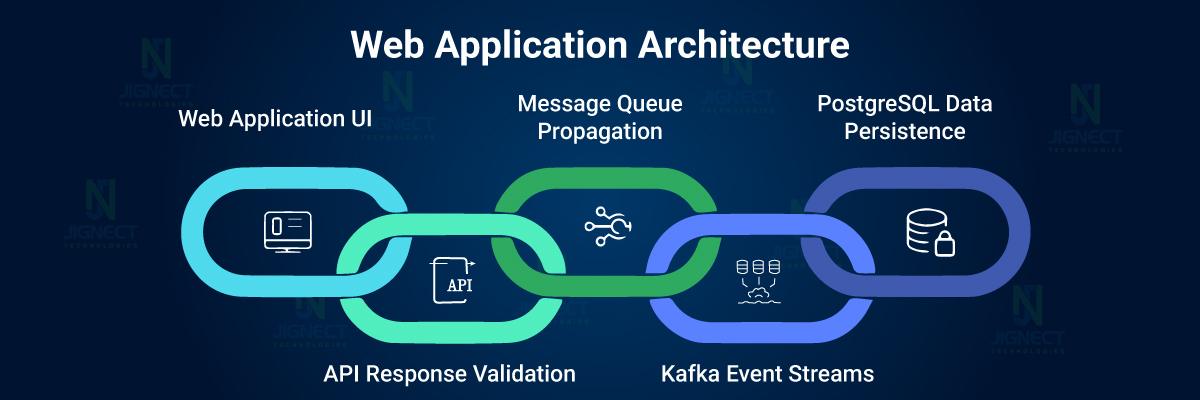
This approach enabled high-fidelity validation of complex IoT workflows, command execution statuses, and event propagation without requiring a single physical meter.
4. Robust API & Data Automation Framework
To maximize regression efficiency and release confidence, we designed and implemented a robust, end-to-end automation framework utilizing the PyTest (Python) ecosystem.
- 2,500+ Automated API Scenarios covering regression, integration, and release validation.
- Deep Integration Testing validating automated data consistency checks between API payloads, Kafka event streams, and PostgreSQL databases.
Results and Business Impact
Our hybrid QA strategy fundamentally transformed the reliability and release velocity of the smart metering ecosystem.
- 2,500+ API Test Scenarios Automated
- 100+ Critical Defects Caught and Resolved Prior to Production Deployment
- 360° Validation Layers Successfully Covered (UI, API, Database, and Kafka Event Streams)
Key Business Outcomes
- Zero-Hardware Testing Success: Successfully validated end-to-end IoT workflows without physical devices, saving massive overhead costs.
- Accelerated Time-to-Market: Dramatically reduced regression test execution windows through automated PyTest suites running in GitHub Workflows.
- Flawless Data Consistency: Ensured absolute precision of critical energy consumption reports, securing high trust from DISCOMs and industrial clients.
- Built for Scale: Enabled a highly scalable quality assurance blueprint capable of supporting rapid customer onboarding and upcoming product expansions.
Conclusion
By bridging the gap between shift-left practices, multi-layer API automation, and event-driven validation, the platform achieved rock-solid reliability, faster regression cycles, and absolute release confidence. This engagement stands as a prime example of how modern quality engineering can unlock fast, stable deployments for complex smart grid platforms where data accuracy and integration reliability are business critical.
Witness how our meticulous approach and cutting-edge solutions elevated quality and performance to new heights. Begin your journey into the world of software testing excellence. To know more refer to Tools & Technologies & QA Services.
If you would like to learn more about the awesome services we provide, be sure to reach out.
Happy Testing 🙂