Enhancing Platform Quality for an EdTech Web Application through Structured QA and Automation
Client Overview
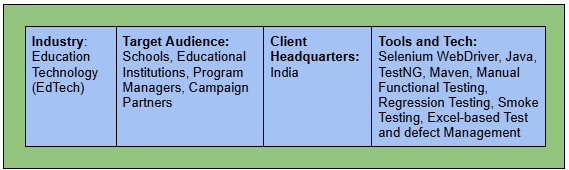
A rapidly growing Education Technology (EdTech) platform was designed to connect schools and educational institutions with organizations through structured engagement initiatives. The platform enables participating schools, administrators, and program stakeholders to manage activities, campaigns, and collaborations through a centralized digital system.
The application operates across web and mobile web environments, allowing users to access the platform from multiple devices. With a rapidly growing user base across educational institutions, maintaining consistent functionality and stable releases became increasingly important.
To support product quality and release reliability, the organization partnered with our QA team to establish a structured testing approach covering functional validation, defect management, and automation.
Business Challenges
As the platform continued expanding across multiple schools and educational networks, the development team faced several challenges in maintaining consistent product quality:
- Frequent feature updates requiring repeated validation
- Ensuring reliable functionality across web and mobile web applications used by educational institutions
- High manual effort required for regression testing
- Limited automation coverage for critical workflows
- Difficulty maintaining structured defect tracking and validation history
- Need for consistent UI and responsive behavior across devices used by students, school administrators, and program managers
These challenges required a systematic QA strategy capable of supporting the platform’s growth while ensuring reliable user experience.
QA Approach & Solution
Our QA team implemented a comprehensive quality assurance strategy combining functional testing, structured documentation, and automation to support the platform’s stability.
Requirement Understanding & Feature Analysis
Testing activities began with a detailed understanding of feature workflows and application behavior. This included analyzing how different modules interacted within the education engagement platform and identifying potential edge cases affecting the experience of schools and program administrators.
Active participation in requirement discussions and feature walkthroughs helped ensure that testing aligned closely with platform functionality.
Test Case Design & Documentation
To ensure comprehensive validation of platform functionality, structured test documentation was created.
Key contributions included:
- Creation of a large repository of feature-level and end-to-end test cases covering multiple platform workflows
- Documentation of scenarios supporting interactions between schools, administrators, and program partners
- Maintenance of structured test case documentation in Excel to support traceability and consistent validation
This documentation became the foundation for organized testing across multiple release cycles.
Functional & GUI Testing
Extensive functional validation was conducted across both web and mobile web versions of the platform.
Testing coverage included:
- Functional verification of platform workflows
- GUI and user interface validation
- Responsive behavior across different screen sizes
- Cross-device validation and cross browser validation to support accessibility for educational institutions using various devices
- Testing performed in both development and staging environments
These validations ensured a stable and consistent experience for platform users across environments.
Defect Reporting & Bug Tracking
A structured defect reporting and tracking process was maintained throughout the project lifecycle.
Key activities included:
- Reporting defects identified during feature testing, regression testing, smoke testing, and ad-hoc validations
- Documenting detailed reproduction steps and observations
- Collaborating closely with developers to validate fixes and confirm issue resolution
This process helped maintain transparency and ensured efficient issue resolution.
Regression & Release Validation
To maintain platform reliability during frequent updates, structured testing cycles were implemented.
Testing activities included:
- Regular regression testing cycles validating thousands of existing scenarios
- Smoke testing before every production release to ensure system readiness
- Additional ad-hoc validation for critical workflows affecting schools and program participants
These practices helped ensure stable and reliable deployments.
Automation Implementation
To reduce repetitive manual effort and improve long-term scalability, automation was introduced using a Selenium-based framework. Automation scripts were developed for high-priority regression scenarios to reduce repeated manual execution. Automation planning included estimation, framework usage, and documentation to ensure maintainability and future scalability.
Results & Business Impact
The QA initiative delivered measurable improvements to the platform’s testing process and overall product reliability.
| QA Activity | Contribution |
| Test Cases Designed | 5,000+ feature and end-to-end test cases |
| Defects Identified | 800+ issues reported and validated |
| Test Environments | Development and Staging environments |
| Platforms Tested | Web Application and Mobile Web |
| Automation Coverage | Selenium WebDriver, Java, TestNG, Maven framework |
| Testing Types | Functional, Regression, Smoke, GUI, Responsive Testing |
| User Scale | Platform supporting 500,000+ users across schools and institutions |
These improvements helped the development team release new features with greater confidence while maintaining platform quality.
Conclusion
Through a structured quality assurance strategy combining functional testing, organized documentation, defect management, and Selenium-based automation, the platform achieved improved stability and more efficient release validation.
The implemented testing framework ensured reliable performance for a platform supporting thousands of schools and educational stakeholders, demonstrating how a focused QA approach can effectively support large-scale Education Technology platforms.
Witness how our meticulous approach and cutting-edge solutions elevated quality and performance to new heights. Begin your journey into the world of software testing excellence. To know more refer to Tools & Technologies & QA Services.
If you would like to learn more about the awesome services we provide, be sure to reach out.
Happy Testing 🙂