Delivering AI-Assisted Quality Engineering for a Workforce Management Solution
Client Overview
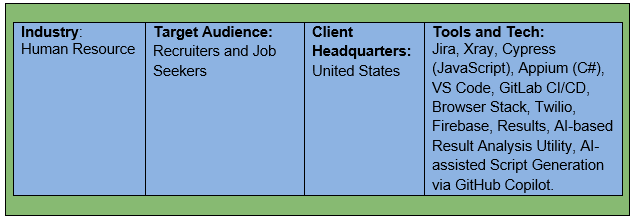
A rapidly growing recruitment and workforce management platform was designed to connect recruiters, staffing agencies, and job seekers through a unified digital ecosystem. The platform helps organizations manage recruitment operations, candidate onboarding, workforce scheduling, and employment workflows across multiple user roles.
The solution is available through web and mobile applications and serves customers across the United States. Because the product shipped frequent enhancements in short development sprints and supported multiple user personas—including Customers, Associates, and Job Control Center (JCC) users across Customer Web Portal, Associate Web Portal, JCC Web Portal, Associate Mobile App, and Customer Mobile App—the platform required continuous validation to protect user experience and business continuity.
To support rapid product evolution while maintaining high-quality standards, the organization partnered with our QA team to establish a comprehensive software quality assurance strategy. The engagement focused on scalable web and mobile automation, continuous regression testing, AI-assisted validation, and CI/CD-driven quality assurance to accelerate releases, improve product stability, and reduce production defects.
The Core Challenges
Client’s Business Roadblocks
- Aggressive 15-Day Sprint Cadence: Frequent feature releases every two weeks created intense pressure to perform fast, comprehensive regression testing before every production deployment.
- Complex, High-Volume Workflows: Long end-to-end business scenarios drastically increased manual execution times, creating severe release delays.
- Multi-Portal & Multi-Platform Complexity: Testing required synchronized cross-portal validation across web and mobile app platforms for three distinct user roles.
- Manual Testing Bottlenecks: Heavy reliance on manual verification, limited testing scalability, lengthened release cycles, and delayed critical deployment decisions.
Our Technical Challenges
- A shared testing environment experienced frequent post-deployment fixes, causing unstable executions.
- Feature Flag implementations introduced inconsistent application behavior, where automated scripts could fail depending on enabled or disabled features.
- Maintaining high automation stability while continuously supporting newly released functionality requires ongoing optimization.
- Flaky test cases had to be identified and stabilized immediately to maintain trustworthy pipeline results.
Our QA Strategy
Our team implemented a comprehensive Quality Engineering framework focused on scalability, stability, and continuous delivery.
Intelligent Automation Framework
- Automated 900+ web test scenarios using Cypress (JavaScript) with a scalable framework leveraging Page Object Model (POM), reusable DTOs, and modular architecture.
- Automated 400+ mobile test scenarios using Appium C#, leveraging APIs for pre-execution test data setup and post-execution validation across integrated web applications and mobile apps.
- Developed end-to-end web cross-portal UI automation covering Customer, Associate, and Job Control Center (JCC) workflows with comprehensive role-based validation.
Continuous Integration & Quality Gates
- Configured scheduled GitLab pipelines for daily automation regression suite execution
- Integrated BrowserStack for reliable cloud-based mobile execution.
- Developed an automated utility to retrieve the latest mobile build from Firebase for local execution and CI pipelines.
- Generated centralized execution reports to support faster release-readiness assessment.
- Leveraged BrowserStack Dashboard during client demonstrations to explain execution results, device coverage, and failure analysis.
AI-Assisted Quality Engineering
- Leveraged AI prompts to accelerate the development of automation scripts, Page Objects, DTOs, and reusable framework components.
- Built AI-powered parsers to automatically inspect and verify test execution results across GitLab CI/CD pipelines and BrowserStack.
- Developed custom AI scripts to analyze stack traces, flag root causes, and recommend smart local reruns for flaky tests.
Automation Governance & Continuous Improvement
To improve project visibility and planning, every sprint included:
- Automation dashboard shared with stakeholders after every sprint.
- Conducted regular discussions with Functional QA teams on newly developed features to maintain application knowledge consistency and support quarterly automation planning.
- Quarterly automation roadmap and goal planning.
- Manual QA validation before automation implementation started.
- Performed root cause analysis of flaky and failed test cases to continuously improve automation stability.
- Yearly automation achievements documented to demonstrate framework growth, coverage improvements, and business value delivered.
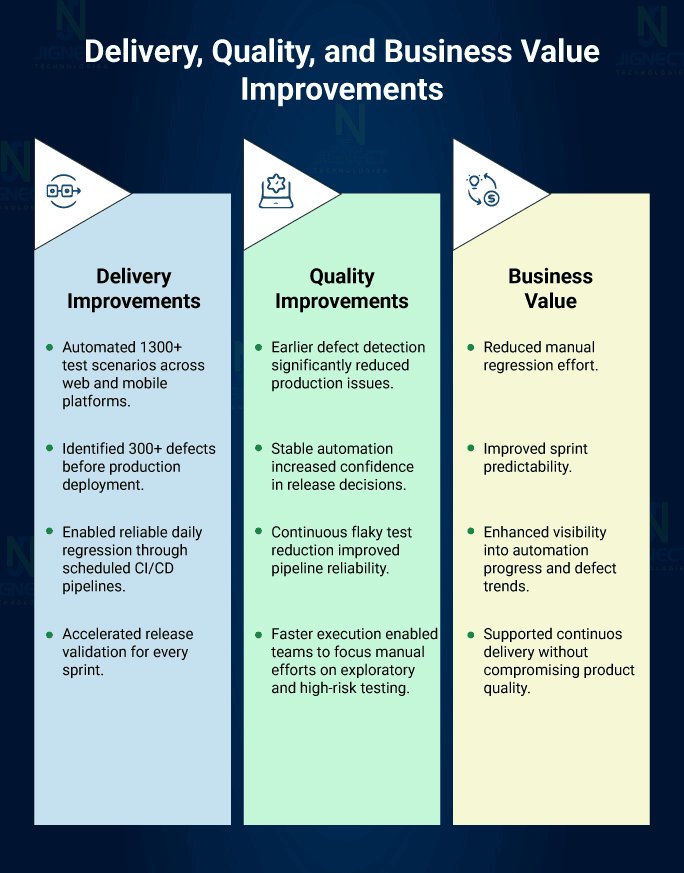
Business Impact & Effectiveness
The implemented automation strategy delivered measurable improvements across the QA lifecycle.
Key Lessons & Adaptive Problem-Solving
Throughout implementation, the team continuously adapted its automation strategy to evolving application behavior.
Feature Flag Management
Feature Flags frequently introduced UI and functional variations that could invalidate existing automation scripts.
Solution:
- Enhanced automation logic to accommodate feature-specific workflows.
- Continuously updated locators and validation strategies based on active feature configurations.
- Coordinated closely with development teams to align automation with feature rollout plans.
Environment Stability
Frequent deployment fixes in the shared testing environment resulted in intermittent failures.
Solution:
- Improved failure analysis through AI-assisted utilities.
- Prioritized flaky test stabilization after each execution cycle.
- Used scheduled regression pipelines to quickly validate deployment quality and isolate environment-related failures.
Continuous Improvement
The project demonstrated that automation success depends not only on increasing coverage but also on maintaining execution stability, continuously refining automation frameworks, leveraging AI to accelerate engineering activities, and establishing structured governance through sprint, quarterly, and yearly automation planning.
Conclusion
This engagement transformed the client’s regression testing process into a scalable, AI-assisted Quality Engineering ecosystem. By combining robust web and mobile automation, continuous integration pipelines, intelligent result analysis, and proactive test maintenance, the team enabled faster releases, improved product stability, and substantially reduced manual testing effort. The solution continues to support rapid feature delivery while providing reliable quality assurance across the client’s human resource platform.
Witness how our meticulous approach and cutting-edge solutions elevated quality and performance to new heights. Begin your journey into the world of software testing excellence. To know more refer to Tools & Technologies & QA Services.
If you would like to learn more about the awesome services we provide, be sure to reach out.
Happy Testing 🙂