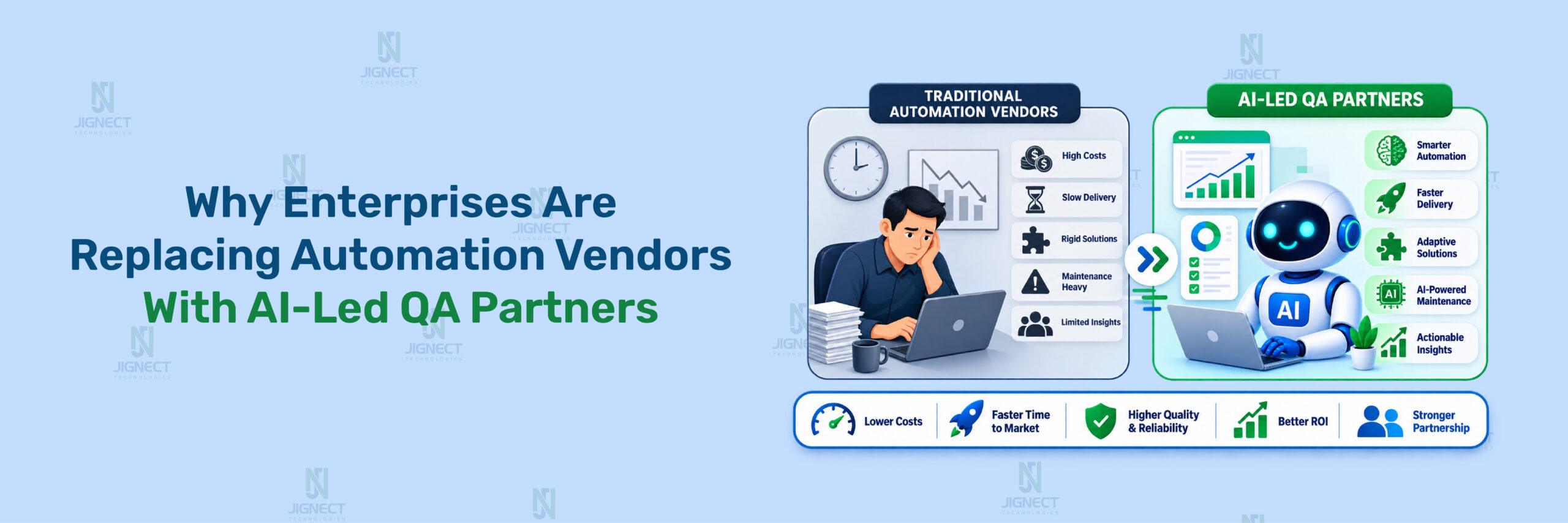

Something is changing in how enterprises buy QA services, and it is happening faster than most automation vendors have registered.
For two decades, the default model was straightforward: you hired an automation vendor, they wrote scripts, maintained a framework, and ran regression cycles. The vendor’s value proposition rested on how many test cases they could execute and how quickly they could add more. It was a volume business. Enterprises measured it in coverage percentages and defect counts. Everyone understood the terms.
That model is breaking down. Not because automation is wrong, but because automation alone has stopped being enough for the kind of software enterprises are now shipping. When your product has AI features, when your release cadence is measured in days rather than months, when your regulatory exposure is tied to the behaviour of a machine learning model rather than a form field, a vendor who writes Selenium scripts faster than anyone else is not solving the problem you actually have.
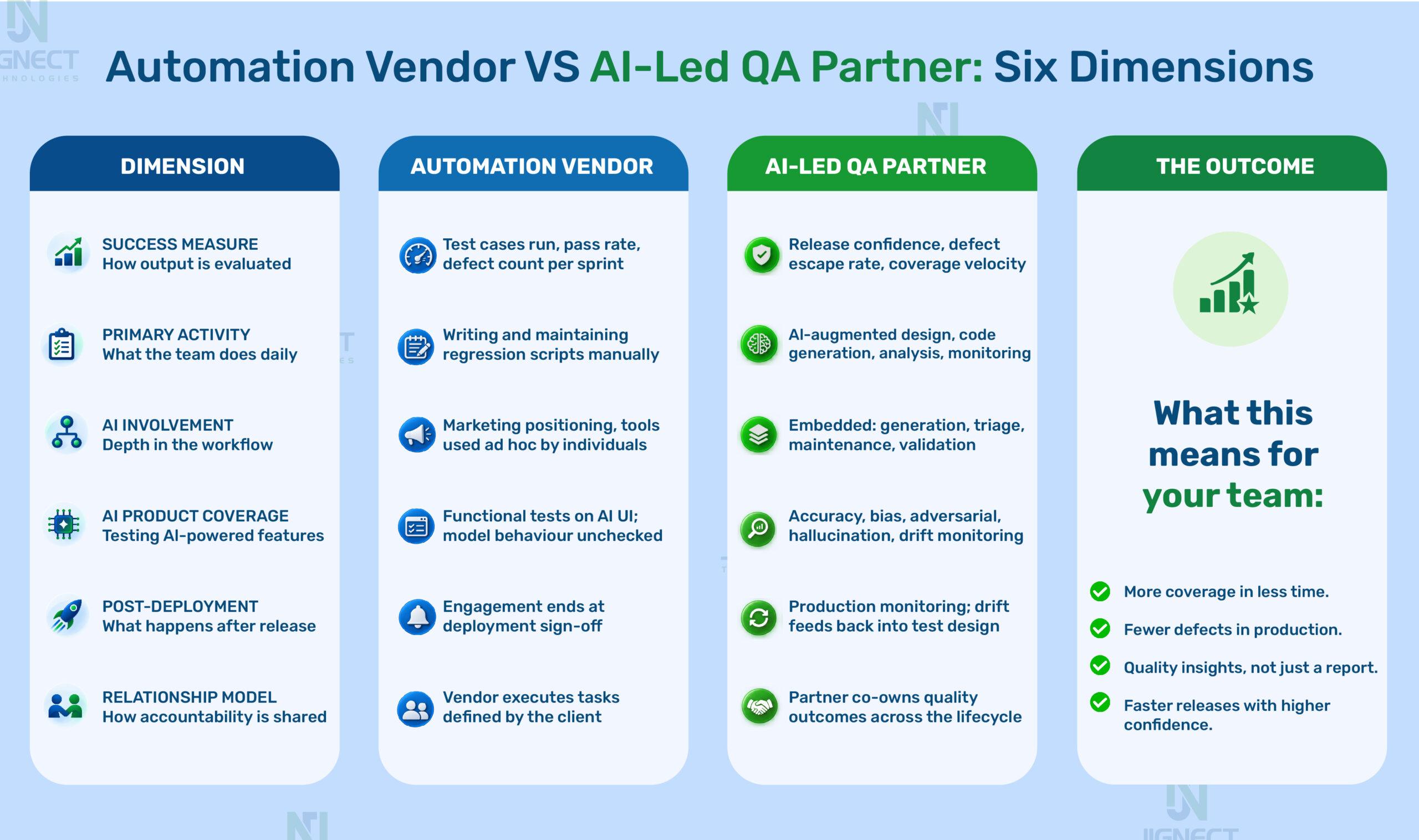
The enterprises that recognised this first have already made the shift. They are not replacing QA. They are replacing a particular definition of QA: one where the function is test execution and the measure of success is how many tests ran. They are replacing it with something that looks more like a quality engineering partnership, where AI is embedded in the workflow from requirement analysis through production monitoring, where the partner brings capability rather than headcount, and where the relationship is measured in outcomes rather than output.
This blog explains why that shift is happening, what it looks like in practice, and what separates an AI-led QA partner from an automation vendor who has simply added “AI” to their marketing deck
- The Automation Vendor Model: What It Was Built For
- Why That Model Is Breaking Down Now
- What Enterprises Are Actually Looking For Now
- The Eight Practices That Define a Real AI-Led QA Partner
- AI-Assisted Test Design from Requirements
- Intelligent Risk-Based Test Prioritisation
- AI-Powered Test Code Generation and Maintenance
- Continuous Failure Analysis and Root Cause Intelligence
- AI/ML Model Validation as a Core Discipline
- Prompt-Driven QA Workflows with Governed Libraries
- Shift-Left Quality with AI-Augmented Coverage Planning
- Production Monitoring and Feedback Loop Management
- The Tools That Separate AI Theatre from AI Practice
- What the Transition Looks Like for an Enterprise
- Questions Every Enterprise Should Ask Before Choosing a QA Partner
- How JigNect Operates as an AI-Led Quality Engineering Partner
- Closing Thoughts
1. The Automation Vendor Model: What It Was Built For
It is worth being precise about what the traditional automation vendor model was designed to do, because it was genuinely well-designed for the problem it was solving.
In the era of quarterly release cycles, monolithic applications, and stable UI surfaces, the challenge was execution throughput. A QA team could not manually run thousands of regression tests before every release. Automation solved that. You invested in a framework, built a library of scripts, and every release ran against a consistent test suite. The vendor’s job was to build and maintain that library. The enterprise’s job was to define the requirements and accept the results.
That model worked well when: releases happened slowly enough that test maintenance could keep pace, the application surface was stable enough that locators did not break constantly, the test matrix was finite and well-understood, and quality was defined by whether known functionality still worked as expected.
None of those conditions hold for most enterprise software in 2025 and 2026. The release cadence has accelerated to the point where some teams deploy multiple times per day. The application surface now includes AI-generated content, probabilistic outputs, and model-driven decisions that change behaviour without a code change. The test matrix is no longer finite because user behaviour is no longer predictable in the way it once was. And quality is no longer defined only by functional correctness. It includes fairness, safety, performance under realistic load, accessibility compliance, and the behaviour of AI components that do not work the same way twice.
A vendor built for the old conditions is not malfunctioning. They are just solving a problem that is no longer the primary one.
2. Why That Model Is Breaking Down Now
2.1 The Speed Problem
The first pressure is pace. When a development team ships code multiple times per week, the traditional automation vendor model hits a structural wall. Test scripts are written after development. The maintenance queue builds faster than it can be cleared. Coverage gaps widen with every sprint because the backlog of untested features grows faster than the automation team can script them.
This is not a resourcing problem that more headcount solves. Adding more script writers does not close the gap because the gap is architectural: the model requires human beings to translate every requirement into test code, and human beings are slower than the development pipeline that generates requirements.
AI-assisted test generation changes this at a structural level. When a QA engineer can produce a test suite from acceptance criteria in minutes rather than hours, the automation pipeline can keep pace with the development pipeline. The constraint shifts from how fast tests can be written to how quickly they can be reviewed and validated. That is a much more manageable constraint, because it is a judgment-intensive activity rather than a mechanical one, and judgment-intensive work actually benefits from human involvement rather than being slowed by it.
2.2 The AI Product Problem
The second pressure is the nature of the products being tested. A large and growing proportion of enterprise software now includes AI features: recommendation engines, conversational interfaces, document processing pipelines, predictive analytics, content generation tools. These components fail in ways that traditional automation frameworks cannot catch.
An AI feature that produces plausible-looking but factually incorrect output passes every functional test. A recommendation engine that works correctly on average but systematically underserves users in specific demographic segments passes every coverage check. A language model feature that behaves differently under adversarial inputs that nobody put in the test suite passes every regression run.
Catching these failure modes requires a different discipline: model accuracy validation, bias and fairness testing, adversarial input testing, hallucination detection, and production drift monitoring. None of this is in the service catalogue of a traditional automation vendor. It requires QA engineers who understand machine learning concepts, who can design property-based evaluations rather than value-matching assertions, and who treat deployment as the beginning of quality monitoring rather than its conclusion.
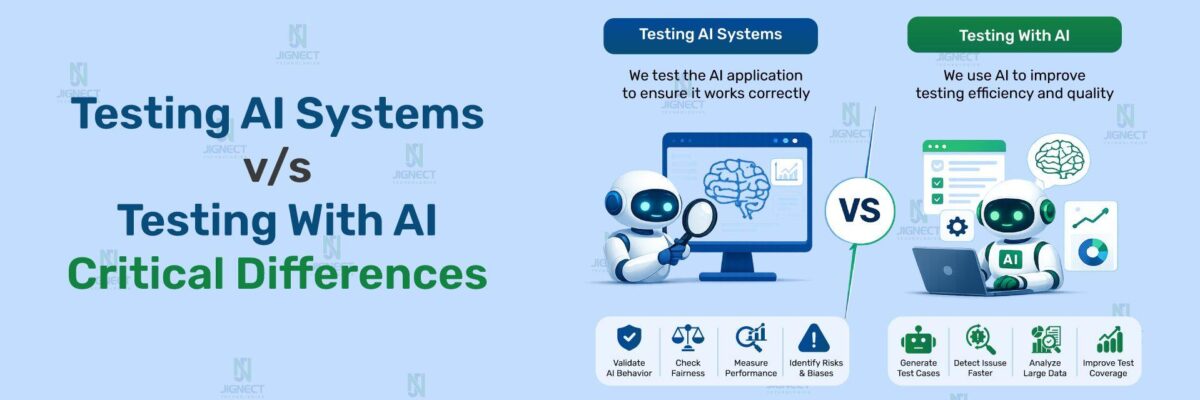
We have covered this distinction in depth in the blog on Testing AI Systems Versus Testing with AI: Critical Differences, which outlines why applying traditional QA methods to AI components leaves the most important failure modes entirely uncaught.
2.3 The Maintenance Treadmill
The third pressure is the maintenance cost of traditional automation. In a typical automation vendor engagement, a significant portion of the QA team’s time goes not to creating new coverage but to keeping existing coverage from degrading. Locators break when developers refactor the UI. Test data becomes stale. Environmental dependencies cause intermittent failures that require investigation to distinguish from genuine defects. Framework dependencies fall behind the application’s technology stack.
The maintenance treadmill is a structural feature of script-based automation, not an execution failure. Every test case added to the suite adds to the maintenance burden. At scale, this creates a perverse dynamic where a large automation suite consumes more engineering time than a smaller, better-maintained one would, and still provides less reliable signal because the noise-to-signal ratio of a large, partially-maintained suite is high.
AI-assisted maintenance breaks this dynamic. Self-healing locators, AI-generated locator alternatives when elements change, failure triage that distinguishes genuine defects from environmental noise automatically, and test gap analysis that tells the team where coverage has degraded rather than requiring them to audit thousands of scripts manually: these capabilities change the economics of maintaining a large automation suite in ways that matter directly to the enterprise P&L.
2.4 The Insight Gap
The fourth pressure is the question of what the QA engagement actually tells the business. Traditional automation vendors provide test execution reports: how many tests ran, how many passed, how many failed. These reports answer the question “did known functionality still work?” They do not answer the questions that enterprise engineering leaders now need to answer: Where are the highest-risk areas in the next release? Which components are accumulating the most defect density? Is our AI model degrading in production? Are we likely to have a quality incident before the next release based on what we know right now?
An AI-led QA partner answers those questions. Predictive defect analysis, risk-based test prioritisation based on code change patterns, production quality telemetry, and trend analysis across releases are not reporting features. They are the analytical outputs that allow engineering leadership to make informed decisions about where to invest QA effort and when to hold a release. They are the difference between QA as a gating function and QA as a strategic input into engineering decisions.
3. What Enterprises Are Actually Looking For Now
Across engineering organisations that are actively evaluating QA partners right now, the criteria have shifted in a direction that traditional automation vendors are structurally unprepared to meet.
The question that was once “how many test cases can you run per sprint” has become “how quickly can you give us meaningful signal about release readiness.” The question that was once “how many engineers do you have available” has become “what is the AI toolchain your team operates, and how does it integrate with our development pipeline.” The question that was once “can you maintain our existing framework” has become “can you tell us whether our framework is still the right architecture given how our product has evolved.”
The enterprises moving fastest on this shift tend to share a few characteristics. They are shipping AI features and need a partner who can validate them properly, not just confirm that the UI rendered correctly. They are on aggressive release cadences and need QA coverage that keeps pace with development rather than trailing behind it. They have accumulated technical debt in their test automation and need a partner who can analyse it honestly rather than simply maintaining it. And they are in industries, financial services, healthcare, legal technology, where the regulatory consequences of a quality failure are significant enough that they need a partner who understands compliance-relevant quality, not just functional testing.
The enterprises that are getting this right are not asking their QA partner to do more of what they already do. They are asking them to fundamentally change what they do: from test execution to quality intelligence, from script maintenance to AI-augmented coverage, from periodic reporting to continuous production monitoring.
What they are looking for, stated plainly, is a partner whose team uses AI the way a QA engineer who is five years ahead of the current market would use it. Not as a novelty. Not as a productivity feature layered on top of the same underlying workflow. As the workflow itself.
4. The Eight Practices That Define a Real AI-Led QA Partner
The gap between a vendor who markets AI capabilities and a partner who actually delivers them is wide, and it is visible in the specific practices the team follows rather than in the service catalogue language. Here are the eight practices that separate genuine AI-led quality engineering from automation with an AI label attached.
PRACTICE 4.1
AI-Assisted Test Design from Requirements
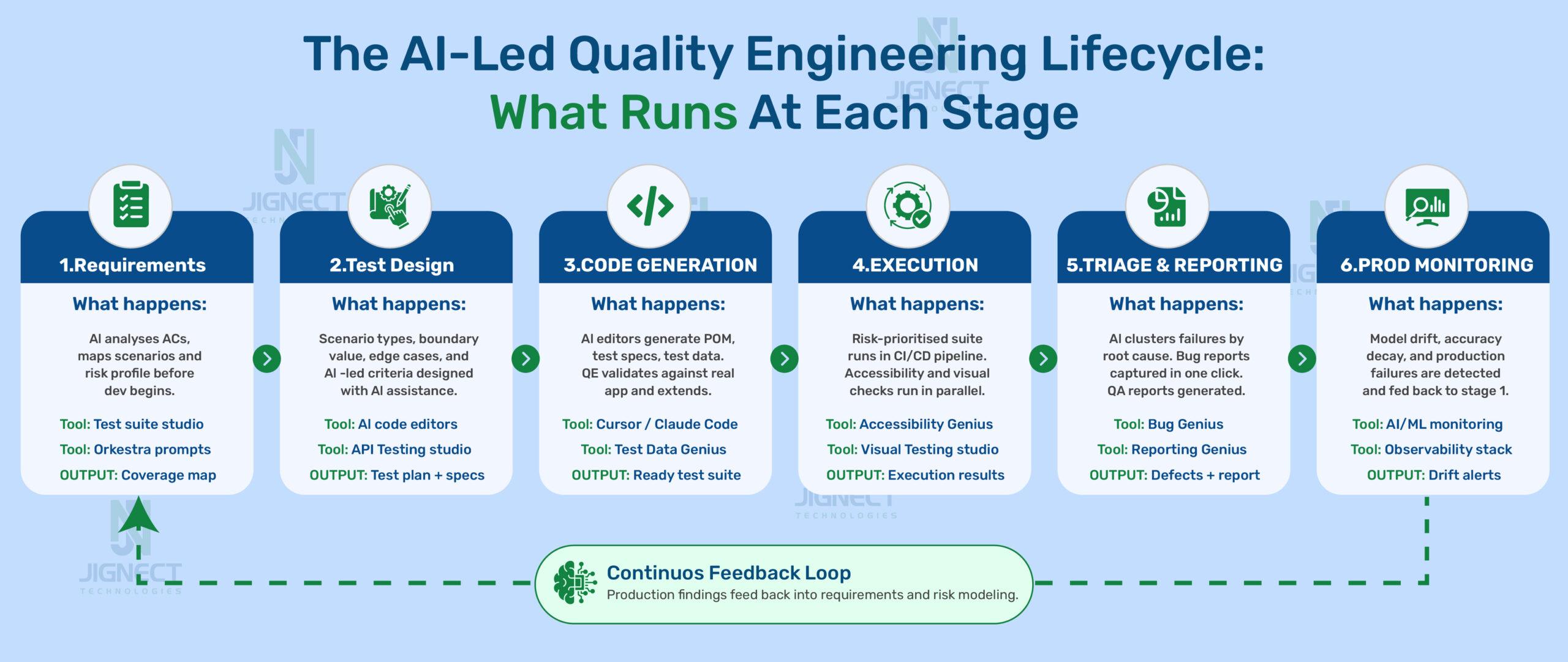
A real AI-led QA partner begins generating test coverage at the requirements stage, not after development is complete. Using AI to analyse acceptance criteria, user stories, and design documents, the team builds a structured coverage map before a line of application code exists. Tools like Test Suite Studio handle this at the planning stage: requirements go in, testable scenarios and coverage maps come out, before the IDE opens. This coverage map identifies the scenario categories that need to be tested, the boundary conditions implied by the requirements, the edge cases that the requirements do not explicitly state but that domain knowledge and risk analysis suggest are important, and the integration points where multiple components interact in ways that create compounded risk. By the time development delivers a feature, the test design is largely complete. The team’s job shifts from starting from scratch to validating and extending what was designed in planning. This is what shift-left quality looks like when AI is genuinely embedded in the workflow, as distinct from a manual QA process that simply moves test writing slightly earlier in the sprint.
PRACTICE 4.2
Intelligent Risk-Based Test Prioritisation
Not all tests are equal, and not all failures are equally likely. An AI-led partner uses code change analysis, defect history, component dependency mapping, and coverage telemetry to make explicit, data-driven decisions about where to focus test effort in each sprint. A change touching a low-risk, well-tested utility function gets a different level of test attention than a change touching the payment processing module that has a documented defect history and three upstream dependencies. This kind of prioritisation exists in principle in traditional QA. In practice, it requires analytical work that most teams do not have the bandwidth to perform sprint by sprint. AI tools make it systematic: the risk profile of each release is computed from the available data and the test strategy responds to it, rather than running the same regression suite regardless of what changed.
PRACTICE 4.3
AI-Powered Test Code Generation and Maintenance
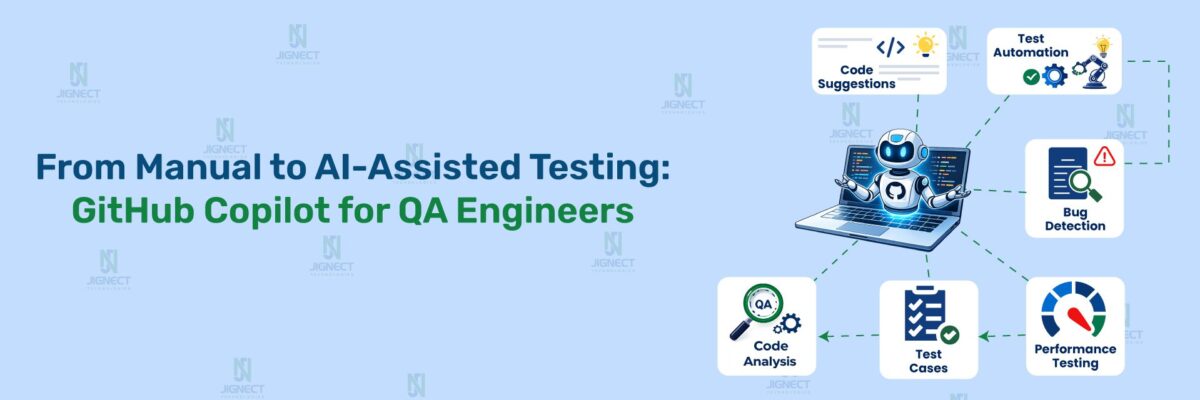
Test code generation using AI code editors, Cursor, Claude Code, GitHub Copilot, and similar tools, is a standard part of how a real AI-led QA team works. Page Objects, test specs, API test suites, and test data factories are not written manually from scratch. They are generated from well-structured prompts that encode the project’s framework conventions, selector strategy, and scenario requirements, then reviewed and extended by a QA engineer who validates the output against the actual application and adds the domain-specific scenarios the AI could not derive from the requirements alone. The team maintains a shared prompt library that encodes the prompting patterns that produce the most reliable output, so the capability is institutional rather than individual. On the maintenance side, AI assists with locator repair when UI changes break existing selectors, failure triage that distinguishes genuine defects from environmental noise, and coverage gap analysis across the suite.
PRACTICE 4.4
Continuous Failure Analysis and Root Cause Intelligence
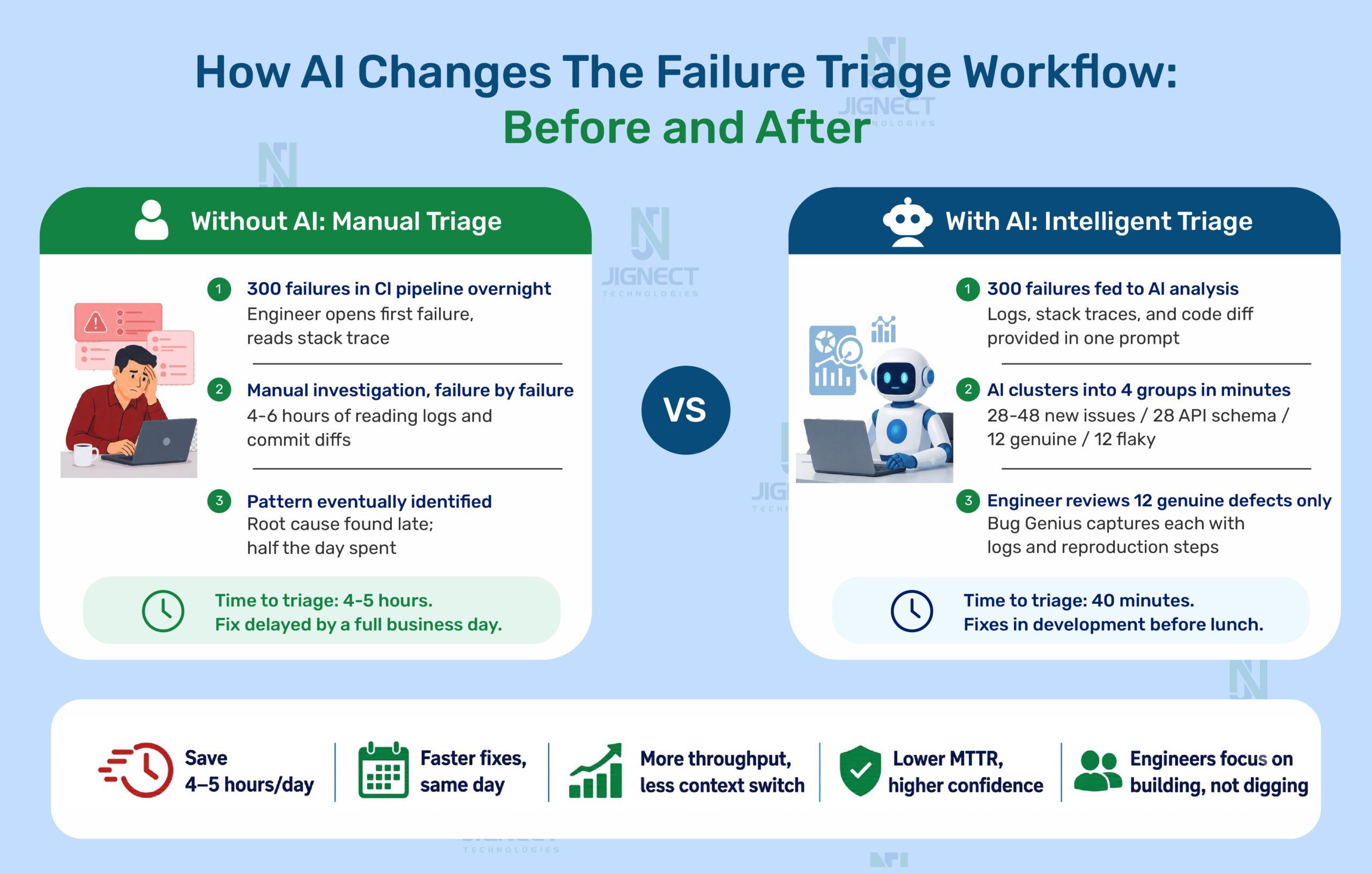
When a CI/CD pipeline produces hundreds of test failures overnight, the response of a traditional automation vendor is to assign engineers to investigate them manually. The response of an AI-led partner is different: AI analysis clusters the failures by root cause, distinguishes environmental issues from genuine defects, identifies the code changes most likely responsible, and surfaces the twelve failures that need immediate human attention from the two hundred that share a common, resolvable infrastructure cause. When genuine defects are found, Bug Genius captures them from the browser with console logs, network traces, and reproduction steps in a single click, removing the back-and-forth between QA and development that delays resolution. This changes the economics of large-scale test failure dramatically: an investigation that used to take a full day takes a fraction of the morning, and developers receive everything they need to reproduce and fix without a follow-up conversation.
PRACTICE 4.5
AI/ML Model Validation as a Core Discipline
For enterprises shipping AI-powered products, a QA partner who cannot validate AI components is leaving the most important failure modes unchecked. A real AI-led partner has AI/ML testing as a core service, not a peripheral offering. This means model accuracy evaluation against labelled test datasets, bias and fairness testing across demographic segments, adversarial input testing to probe safety boundaries, hallucination detection for language model features, confidence calibration assessment, and production drift monitoring to catch model degradation before it impacts users. These are not automated test scripts. They require QA engineers who understand machine learning well enough to design meaningful evaluations, and a partner who has built the methodology and tooling to deliver them at the pace enterprise delivery cycles require.
PRACTICE 4.6
Prompt-Driven QA Workflows with Governed Libraries
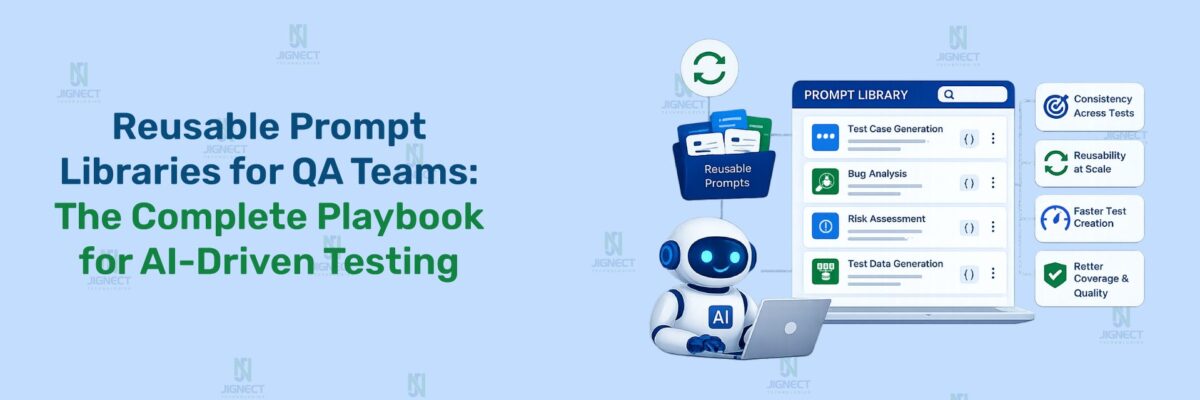
The shift to AI-assisted QA does not happen by accident. It requires deliberate investment in the prompting infrastructure that makes AI output reliable at scale. A real AI-led QA partner maintains governed prompt libraries for test case generation, bug report production, failure analysis, accessibility audit documentation, and coverage gap identification. These libraries are versioned, reviewed, and refined based on which prompt structures consistently produce output that requires minimal rework. They are accessible across the team, not siloed with individual engineers. And they are governed: there are clear standards for what constitutes acceptable AI-generated output, and clear review processes for validating AI output before it enters the testing pipeline. The tooling that makes this sustainable at the organisational level, including Orkestraa’s Prompt Studio, collaborative workspaces, and multi-LLM governance, is part of the infrastructure a mature AI-led QA partner operates.
PRACTICE 4.7
Shift-Left Quality with AI-Augmented Coverage Planning
Shift-left testing is not new as a concept. What is new is the ability to actually execute it at the pace modern development requires. When test design is powered by AI, the coverage planning that previously could not happen until requirements were fully documented and development had begun can now start from early-stage requirements, expand as the design matures, and be substantially complete before the first line of implementation code is delivered. This changes the economics of finding defects. A defect found during test design costs a fraction of a defect found during system testing, and a fraction of a fraction of a defect found in production. AI-augmented shift-left quality is not a philosophical position. It is a cost reduction strategy, a release confidence strategy, and a competitive advantage in organisations where time to market is a meaningful differentiator.
PRACTICE 4.8
Production Monitoring and Feedback Loop Management
Quality does not end at deployment. For enterprises shipping AI-powered products, in particular, deployment is where the most important quality monitoring begins. A real AI-led QA partner treats production monitoring as a QA responsibility, not solely a DevOps one. This means monitoring AI model performance metrics in production, detecting drift as real-world data distributions shift away from training distributions, alerting on accuracy degradation before it reaches thresholds that impact users, and feeding production failure patterns back into the test design process so the next sprint addresses the failure modes that are actually occurring in real usage. The feedback loop between production monitoring and test design is what makes quality engineering continuously improving rather than periodically reset.
5. The Tools That Separate AI Theatre from AI Practice
One of the clearest ways to distinguish a vendor who uses “AI” as a marketing term from a partner who has actually built AI into their workflow is to ask about specific tooling. Not which tools they have licences for. Which tools their engineers used in the last sprint, what they used them for, and what the output looked like.
An AI-led QA team’s toolchain in 2026 looks substantially different from a traditional automation team’s toolchain. It is worth naming what that looks like concretely.
For test code generation and maintenance, the team uses AI code editors as a standard part of the development workflow: GitHub Copilot and Cursor for pattern-based generation and Composer-mode multi-file output, Claude Code for analytical reasoning across the full test suite and coverage gap identification, Windsurf for teams running Playwright with its native MCP integration, and Cline for autonomous test-run-iterate cycles and maintenance work that benefits from an approval-gated autonomous agent.
For browser-level QA augmentation, the team uses the AIdriventesting.ai Chrome extension and web studio suite: six Chrome extensions covering bug capture, test data generation, accessibility compliance scanning, CI report generation, scenario-based test execution, and form validation; and four web studios covering test suite design, API testing, one-click automation, and visual regression. Each utility handles a specific, repetitive task in the daily QA workflow that would otherwise consume engineering time that should go toward higher-judgment work.
For prompt governance and team-level AI workflow management, Orkestraa provides the infrastructure that makes AI-assisted QA scale across a team: Prompt Studio for authoring and sharing QA prompts, collaborative workspaces per project, centralised AI token governance, and multi-LLM access across Claude, OpenAI, and Gemini from a single interface.
The question to ask any vendor claiming AI capabilities: which of these tools, or their equivalents, are your engineers using on active engagements right now? The answer tells you whether AI is in the workflow or in the pitch deck.
| Capability area | What it looks like at an AI-led partner | What it looks like at a traditional vendor |
|---|---|---|
| Test design | AI analyses ACs at planning; coverage map before dev starts | QE writes test cases after feature is delivered |
| Test generation | AI code editors produce POM, spec, and data in minutes; reviewed by QE | Manual scripting by automation engineers over hours or days |
| AI component testing | Model accuracy, bias, adversarial, drift monitoring as core services | Functional regression tests pointed at AI features |
| Failure triage | AI clusters failures by root cause; QE investigates flagged defects | Engineers read through failure logs manually |
| Maintenance | AI-assisted locator repair, coverage gap analysis, suite health monitoring | Manual maintenance queue that grows with the suite |
| Production quality | Model drift monitoring, accuracy telemetry, feedback into test design | Post-deployment testing is out of scope |
| Reporting | AI-generated structured reports; predictive quality signals for leadership | Pass/fail counts, defect lists, coverage percentages |
| Prompt infrastructure | Governed prompt library, team-wide access, versioned and refined each sprint | Engineers use AI tools individually with ad hoc prompts |
6. What the Transition Looks Like for an Enterprise
The shift from a traditional automation vendor to an AI-led QA partner does not happen overnight, and the enterprises that navigate it most successfully do not try to make it happen overnight. The transition has a shape, and understanding that shape helps engineering leaders set realistic expectations and avoid the most common mistakes.
The first phase is audit. Before anything else, an AI-led QA partner does an honest assessment of the existing automation estate: what is the current suite covering, what has it missed, how much of the maintenance burden is genuine technical debt, and what would it cost to maintain the current approach versus rebuilding it on a more sustainable architecture. This assessment is often where the conversation with a prospective enterprise becomes most revealing. Traditional vendors rarely perform it because it might identify problems with work they have already delivered. An AI-led partner performs it because the quality of the partnership depends on an accurate baseline.
The second phase is integration. AI tools, workflows, and governance practices are introduced into the existing delivery pipeline incrementally rather than replacing everything simultaneously. The team identifies the highest-value opportunities: the parts of the QA workflow where AI assistance will have the most impact on the metrics the enterprise cares about most. If the biggest pain point is maintenance overhead, AI-assisted locator repair and suite health monitoring come first. If it is coverage velocity, AI test generation and Test Suite Studio come first. If it is AI component validation for a product that has just added AI features, that practice is established as a priority before the next release cycle.
The third phase is steady state, where AI is embedded across the full quality engineering lifecycle and the partnership is measured by outcomes: release confidence, defect escape rate, time from requirement to coverage, and production quality telemetry. The relationship at this point looks nothing like the traditional vendor engagement. The QA team is producing quality intelligence, not just test execution reports. The engineering leadership is making release decisions informed by predictive analysis, not just historical pass rates.
The enterprises that are furthest along in this transition did not make it by finding a vendor with a better AI sales pitch. They made it by finding a partner who was willing to be honest about what the current state was, had a clear methodology for improving it, and had the tools and the team capability to deliver on that methodology at pace.
7. Questions Every Enterprise Should Ask Before Choosing a QA Partner
The market for AI-led QA services is full of vendors who have updated their positioning without updating their practice. Separating genuine capability from repositioned traditional services requires specific, verifiable questions rather than high-level capability discussions.
Can you show us test coverage built with AI generation? Ask to see actual test code that was generated using AI tools in a recent engagement. The output should be idiomatic, correctly structured for the framework, and accompanied by a clear account of what the QE engineer added after review. If the answer is a demo of a generic tool rather than output from a real project, that tells you something important.
How do you test AI features in products? If the vendor describes functional regression tests run against an AI component, they do not have an AI/ML testing practice. The answer should include model accuracy evaluation, fairness testing, adversarial input testing, and production drift monitoring. If any of those terms are unfamiliar, the conversation is over.
What does your prompt library look like? An AI-led QA team that has been doing this seriously for more than a few months has a library of prompt templates that are versioned, team-accessible, and regularly refined. Ask how it is governed, how new engineers are onboarded to it, and how they know which prompts produce the most reliable output. Ad hoc answers to this question indicate the team is using AI tools individually rather than as a systematic capability.
What happens to quality monitoring after deployment? A traditional vendor’s engagement ends at release. An AI-led QA partner’s engagement includes production monitoring, at minimum for AI components. If the answer to this question is blank, the vendor is not operating the production feedback loop that keeps quality improving rather than degrading over time.
How do you integrate with our development pipeline? The answer should be specific about CI/CD integration, the cadence of test runs, how failure triage works, how the QA team receives risk signals from code change analysis, and how coverage gaps are surfaced before rather than after a release. Generic answers about “integrating with your tools” are not sufficient.
What are your engineers doing in a typical sprint? This is the most direct question. The answer from an AI-led team includes specific activities: building coverage maps from requirements using AI analysis, generating test code with AI editors and reviewing it against the application, running AI failure triage after CI runs, maintaining the prompt library, and delivering quality telemetry to engineering leadership. The answer from a repositioned traditional vendor involves script writing and test execution with occasional AI tool usage.
8. How JigNect Operates as an AI-Led Quality Engineering Partner
JigNect has been building toward this model since before the terminology was established. The “Automation Is No Longer Enough” position we articulated in our earlier blog on AI-driven quality engineering is not a repositioning for the current market. It reflects how our practice has been evolving for the past several years, and it now represents a concrete operational methodology rather than an aspiration.
Our quality engineering services span the full AI-in-QA lifecycle: requirement analysis and risk modelling, intelligent test design, AI-assisted automation framework scaffolding, CI/CD integration, production monitoring, and feedback loop management. Each of these stages involves AI tools embedded in the actual workflow, not layered on top of a traditional approach as a productivity feature.
Our AI/ML testing practice handles the validation work that enterprises with AI-powered products need: model accuracy evaluation, bias and fairness testing, adversarial input coverage, and production drift monitoring. Our automation testing practice uses AI code editors as standard tooling for test generation and maintenance. Functional testing, performance testing, accessibility testing, and security testing services all incorporate AI-assisted workflows at the appropriate points in the process.
The AIdriventesting.ai platform, the suite of ten AI-powered QA utilities our team uses and which we make available to client teams, is the practical expression of what AI-in-practice looks like for daily QA work. It is not a product layer separate from our delivery. It is the toolchain our engineers use. When we talk about AI-led quality engineering, these are the specific tools and workflows we mean.
Orkestraa provides the prompt management and governance infrastructure that makes our AI-assisted workflows systematic across engagements and teams rather than dependent on individual engineer capability. The prompt libraries we have built across our QA practice are the accumulated knowledge of what AI assistance looks like when it is applied deliberately and refined over time.
We work across ten industries including healthcare, financial services, e-commerce, education, gaming, travel and hospitality, telecommunications, and legal technology. Each industry brings its own compliance requirements, user expectations, and quality risk profile. Our AI-led approach adapts to those differences rather than applying a generic testing template.
If your organisation is evaluating a move from a traditional automation vendor to an AI-led quality engineering partnership, or if you are trying to assess whether your current QA approach is keeping pace with where your product has evolved to, we are happy to have that conversation with specifics rather than generalities. Get in touch and we can start with an honest assessment of where you are and what closing the gap looks like in your specific context.
Is your current QA approach keeping pace with your product?
JigNect provides an honest assessment of your current quality engineering maturity and a clear view of what AI-led QA looks like for your specific stack, delivery cadence, and product type.
9. Closing Thoughts
The enterprises replacing automation vendors with AI-led QA partners are not doing it because AI is fashionable. They are doing it because the nature of the software they ship has changed, the pace at which they ship it has changed, and the risks they are managing have changed. The QA function that made sense for quarterly releases of deterministic software does not make sense for weekly releases of products that include AI components, serve global user bases with complex accessibility and compliance requirements, and are expected to maintain quality in production rather than just at the point of deployment.
The shift is not primarily about tools. It is about what the QA function is for. A vendor whose function is test execution will adopt AI tools and become faster at test execution. A partner whose function is quality engineering will use those same tools, and the same additional ones, to do something more valuable: give engineering teams the quality intelligence they need to make informed decisions, catch the failure modes that matter most before they reach users, and continuously improve the quality of what they ship rather than simply verifying that it meets a fixed specification.
If you are responsible for software quality at an organisation navigating this shift, the most useful question is not “which vendor has the most AI features.” It is “which partner can show me, specifically and verifiably, what AI-led quality engineering looks like in practice, and what it would look like for us.” The answer to that question separates the genuine from the theatrical quickly.
For related reading on the strategic and technical dimensions of this shift, the blogs on why automation alone is no longer enough, on the journey from automation-first to AI-first quality engineering, and on the critical differences between testing AI systems and testing with AI cover the underlying technical and methodological ground in detail.
Witness how our meticulous approach and cutting-edge solutions have elevated quality and performance to new heights. To know more, refer to Tools and Technologies and QA Services.
If you would like to learn more about the services we provide, be sure to reach out.
Happy Testing 🙂