Accelerating Healthcare Testing: An Automation Strategy to Reduce Manual Effort

Client Overview
A leading healthcare software provider serving home care agencies across the U.S., Canada, New Zealand, and other regions aimed to enhance its comprehensive web-based platform, which is actively used by over 5,000 users across multiple agencies. The platform manages key operational modules such as scheduling, billing, payroll, client management, and compliance tracking – ensuring seamless coordination between caregivers, administrators, and clients while adhering to regulatory standards.
To strengthen product quality and accelerate release timelines, the company collaborated with Jignect Technology to implement a scalable automation framework, enabling validation of critical business workflows like scheduling and payment processing, thereby improving system reliability and delivery efficiency.
Challenges
- Repetitive Regression Testing: Each release required extensive manual revalidation of key modules such as scheduling, billing, and payroll, consuming significant QA effort and time.
- Extended Release Timelines: Manual execution of large test suites delayed deployment schedules and slowed down release velocity.
- Human Error in Complex Scenarios: Manual validation of data-driven workflows increased the risk of oversight in critical areas like payment calculations and compliance tracking.
- Limited Test Coverage: Due to time constraints, the QA team could not cover all functional and regression areas, leading to undetected issues in production.
- Frequent Product Enhancements: Continuous UI and feature updates made it difficult to maintain consistency in manual test execution.
- Lack of Centralized Reporting: Absence of structured test reports reduced visibility into execution progress, defect trends, and overall quality metrics.
- Integration Validation Gaps: End-to-end scenarios spanning web, mobile, and third-party integrations were difficult to validate effectively without automation support.
Our Approach
- Framework Design and Development: Built a scalable, maintainable automation framework from scratch, ensuring modularity and reusability for future feature expansion.
- Structured Test Suite Implementation: Organized automated suites into regression, smoke, and feature-specific categories to support continuous and targeted validation cycles.
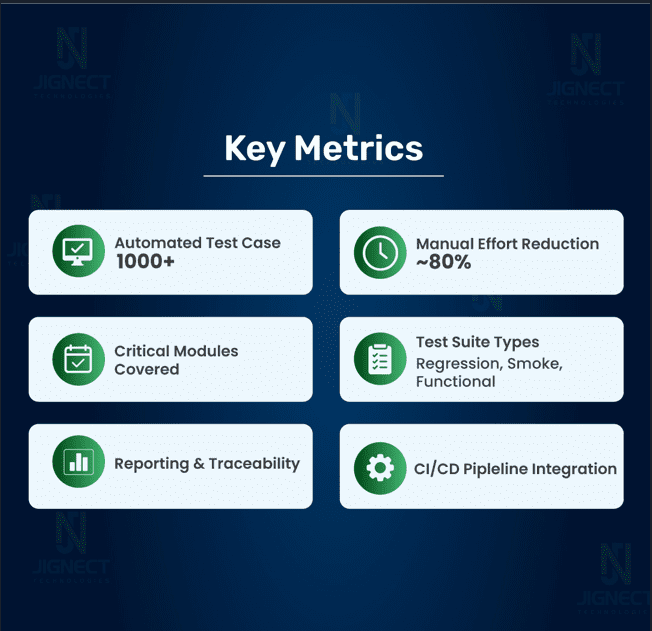
- Comprehensive Test Coverage: Developed and executed over 1,000 automated test cases across critical business workflows, configurations, and integrations.
- Advanced Workflow Validation: Automated complex use cases, including network log capturing, and cross-module dependency validations.
- Robust Reporting and Defect Tracking: Integrated Extent Reports for detailed execution insights, including step-level logs, screenshots, and result summaries. Enabled continuous defect identification during both script development and automated pipeline runs result verifications.
- Critical Module Focus: Prioritized automation of high-impact areas such as scheduling and payment calculations, validating edge cases, configurations, and dependency chains end-to-end.
- Collaborative Execution Model: Conducted regular knowledge transfer sessions and daily sync-ups with the manual QA and development teams to ensure transparency, alignment, and continuous improvement.
Why This Matters:
- Ensures reliability of business-critical workflows such as payments, scheduling, and compliance under all configuration settings.
- Reduces post-release defects, minimizing production issues, customer complaints, and costly fixes.
- Accelerates release cycles by enabling faster feedback and supporting Agile and CI/CD delivery models.
- Improves overall test efficiency and coverage across multiple modules and releases.
- Strengthens stakeholder confidence through detailed reporting, traceability, and execution visibility.
- Establishes a robust and flexible automation setup that can scale with new features, modules, and product enhancements over time.
Results & Impact
Here are the measurable outcomes achieved through this engagement:
| Metric | Result |
| Manual Testing Effort Reduced | Achieved ~80% reduction in manual testing time for automated modules, freeing QA bandwidth for exploratory and new feature testing. |
| Test Coverage | Comprehensive automation coverage across critical workflows – payments, scheduling, and settings – validated under multiple configurations. |
| Defect Detection | Increased early defect detection during script execution and CI pipeline runs, minimizing production leakages. |
| Release Velocity | Accelerated release cycles through faster regression execution and reduced QA turnaround time. |
| Reporting & Traceability | Enhanced visibility with detailed reports, logs, and screenshots, enabling efficient debugging and transparent progress tracking. |
| Quality Assurance Confidence | Improved release stability and stakeholder confidence, especially for high-risk financial and scheduling modules. |
Conclusion
By partnering with Jignect Technology, the client successfully adopted an automation-driven QA approach that minimized manual testing efforts and enhanced confidence in the platform’s stability and performance. With end-to-end automation of complex modules and seamless CI/CD integration, Jignect enabled a future-ready QA process that supports faster releases, improved reliability, and scalable product growth positioning the business for continued innovation, operational efficiency, and confident expansion.
Witness how our meticulous approach and cutting-edge solutions elevated quality and performance to new heights. Begin your journey into the world of software testing excellence. To know more refer to Tools & Technologies & QA Services.
If you would like to learn more about the awesome services we provide, be sure to reach out.
Happy Testing 🙂