Ensuring E-Commerce Scalability with Incremental Load Validation

Overview
A well-established India-based e-commerce enterprise in the Retail & Consumer Goods sector delivers a robust B2B digital commerce platform serving distributors, retailers, and bulk buyers across multiple regions. The platform supports end-to-end procurement workflows — from product discovery and personalized pricing to cart management and secure checkout — while integrating CMS-driven content, backend order processing systems, and inventory management services to ensure a seamless and scalable buying experience.
With increasing user traffic and planned high-volume campaigns, the organization sought to validate its platform’s scalability, checkout stability, and Core Web Vitals performance under peak conditions. To proactively mitigate performance risks and ensure infrastructure readiness, the company engaged our team to conduct structured load testing up to 5000 concurrent users, identify system degradation thresholds, and deliver actionable insights for optimization before scaling production traffic.
Business Challenge
The client faced multiple performance and scalability concerns:
- Inconsistent Core Web Vitals compliance, especially TTFB exceeding the target under load.
- Dynamic CMS-driven and personalized content increasing backend processing latency.
- Need to simulate international traffic from multiple IP locations to assess global performance behavior.
- Mobile performance degradation under Slow 4G and CPU throttling conditions.
- Lack of clarity around system degradation thresholds during high concurrency scenarios.
- Checkout flow instability at peak loads — a high-risk area in e-commerce systems.
Without structured performance validation, infrastructure scaling decisions would remain assumption-driven, increasing the risk of checkout failures during peak demand.
Our Approach: Engineering Performance with Precision
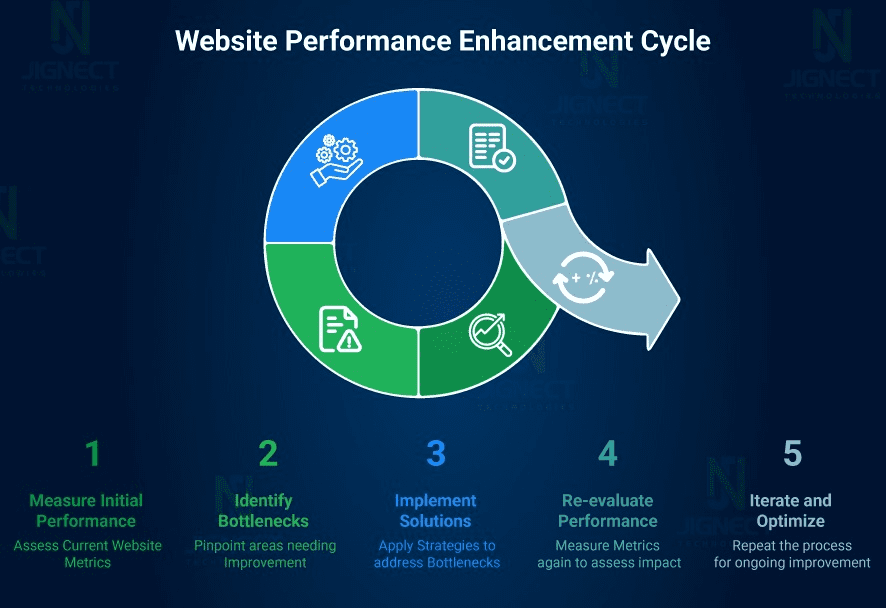
Rather than executing isolated load tests, we implemented a multi-layered performance validation strategy combining scalability testing, frontend diagnostics, and caching analysis.
1. Real-World User Journey Simulation
We replicated high-impact business workflows across two enterprise-grade e-commerce platforms, including:
- Homepage → Login → Category → Product → Cart → Checkout
- Product list page filtering and product comparison
- Personalized landing experiences
- Support and service journeys
- Account and product registration flows
- CMS publishing validation
Each script mirrored realistic user behavior patterns to ensure accurate system stress representation.
Load and stress testing were executed using Apache JMeter, while frontend diagnostics leveraged GTmetrix and Google PageSpeed Insights.
2. Incremental Scalability Validation (25 → 5000 Users)
Instead of immediate stress injection, we adopted a controlled ramp-up strategy:
- Concurrent users increased in batches of 25
- Continuous monitoring of response time, throughput, and error rates
- Identification of performance degradation point
This structured approach revealed that system instability began beyond ~250 concurrent users, particularly affecting checkout APIs. This insight alone prevented potential high-traffic revenue risks.
3. Deep Core Web Vitals & Caching Analysis
- Beyond baseline load validation, we conducted a comprehensive performance deep-dive covering response time patterns, page load behavior, throughput stability, and error rates under progressive concurrency. Core Web Vitals — including LCP, CLS, INP, and TTFB — were evaluated to ensure real-user experience standards were maintained even during traffic spikes.
- Additionally, we analyzed CDN effectiveness, caching strategy, and edge delivery consistency, along with CMS author-to-production publishing performance. Mobile simulations under Slow 4G and CPU throttling further uncovered rendering inefficiencies and personalization overhead, enabling targeted optimization across both frontend and backend layers.
Business Impact
The engagement delivered more than just performance reports – it provided strategic clarity.
- Identified precise scalability threshold (~250+ users)
- Highlighted checkout as the most sensitive performance component
- Distinguished backend latency from frontend rendering delays
- Enabled informed infrastructure scaling decisions
- Reduced risk before marketing and high-traffic campaigns
- Delivered actionable optimization roadmap for Dev and DevOps teams
Most importantly, the client transitioned from reactive firefighting to proactive, data-backed performance planning — enabling confident infrastructure scaling and reduced production risk.
| Metric | Before | After | Status |
| TTFB | 620ms | 165ms | ✅ Excellent |
| LCP | 4.5s | 1.8s | ✅ Pass |
| CLS | 0.29 | 0.04 | ✅ Stable |
| INP | 410ms | 135ms | ✅ Responsive |
| Throughput | 140 req/s | 360 req/s | ↑ 157% |
| Error Rate @5000 users | 4.2% | 0.3% | ↓ 92% |
Conclusion
Through a structured and data-driven performance engineering approach, this engagement transformed scalability uncertainty into measurable confidence. By simulating realistic end-to-end user journeys up to 5000 concurrent users, validating Core Web Vitals under load, and identifying checkout degradation thresholds, we provided the client with clear visibility into system behavior during peak traffic scenarios.
The initiative not only uncovered critical performance bottlenecks but also enabled targeted optimization across infrastructure, backend services, and frontend rendering layers. As a result, the organization gained the confidence to scale traffic strategically, strengthen checkout resilience, and enhance overall platform stability — ensuring a seamless and reliable buying experience even under high-demand conditions.
Witness how our meticulous approach and cutting-edge solutions elevated quality and performance to new heights. Begin your journey into the world of software testing excellence. To know more refer to Tools & Technologies & QA Services.
If you would like to learn more about the awesome services we provide, be sure to reach out.
Happy Testing 🙂