Stabilizing a No-Code, API-Driven Travel & Hospitality Booking Platform Through Scalable QA
Client Overview
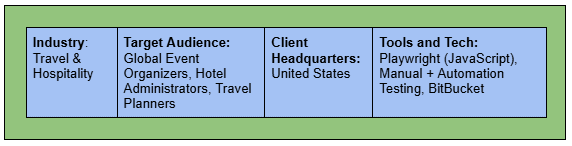
A globally operating event and hospitality technology company delivers an integrated online booking platform that combines event ticketing and hotel reservations into a unified digital experience. Serving customers across multiple countries, the platform enables flexible booking options including event-only, hotel-only, and bundled packages. It supports complex multi-day events, nested sessions, configurable hotel stays, dynamic pricing models, and real-time availability through third-party API integrations.
As the platform incorporated payment processing and multiple third-party integrations, the organization aimed to strengthen pricing accuracy, inventory synchronization, and transactional reliability across interconnected systems. The primary goal was to ensure seamless end-to-end booking workflows, maintain data consistency between external APIs and the application, and enable scalable growth while delivering a stable and dependable customer experience within a dynamic e-commerce ecosystem.
Challenges
The organization faced multiple technical and operational complexities:
- Multi-layered Event Architecture – Managing multi-day events with nested sessions, workshops, and capacity controls.
- Advanced Hotel Inventory Modeling – Supporting room types, board basis (RO, BB, HB, FB, AI), dynamic rate plans, and configurable stay extensions.
- Bundled Pricing Logic – Calculating dynamic pricing for event-only, hotel-only, and combined packages.
- Real-Time Third-Party API Synchronization – Ensuring accurate availability and pricing across external event and hotel systems.
- High Transactional Sensitivity – Validating payments, refunds, vouchers, and cancellation policies without financial discrepancies.
- No-Code Platform Constraints – Limited backend visibility, unstable DOM structures, restricted customization, and automation feasibility challenges.
With increasing user adoption and frequent feature releases, regression risk and production exposure became critical business concerns.
Quality Engineering Strategy
To mitigate operational risk and strengthen release reliability, a structured hybrid validation model (Manual + Automation) was implemented, ensuring both deep functional validation and scalable regression coverage.
Core Initiatives
1. Enterprise-Grade Automation Framework
- Designed a modular, scalable Playwright (JavaScript) architecture
- Built reusable components aligned with platform workflows
- Implemented resilient locator strategies for dynamic UI behavior
2. Strategic Manual Validation Layer
- Executed risk-based manual testing for complex bundled pricing and edge-case scenarios not fully automatable
- Performed exploratory testing for dynamic UI behavior caused by no-code rendering constraints
- Validated payment edge cases, refund scenarios, and API exception handling through controlled manual simulations
- Verified third-party API responses and fallback logic to ensure transactional consistency
3. Stabilization of No-Code UI Constraints
- Applied intelligent wait mechanisms for asynchronous rendering
- Introduced conditional handling for unstable DOM elements
- Reduced flaky test executions through adaptive validation logic
4. End-to-End Business Flow Coverage
Automated validation across critical revenue-impacting journeys:
- Event creation and configuration
- Hotel inventory and rate setup
- Bundled booking workflows
- Checkout, payments, and refunds
- API-driven availability and pricing synchronization
5. Continuous Validation Pipeline
- Integrated daily CI-driven regression execution
- Enabled early defect detection before production deployment
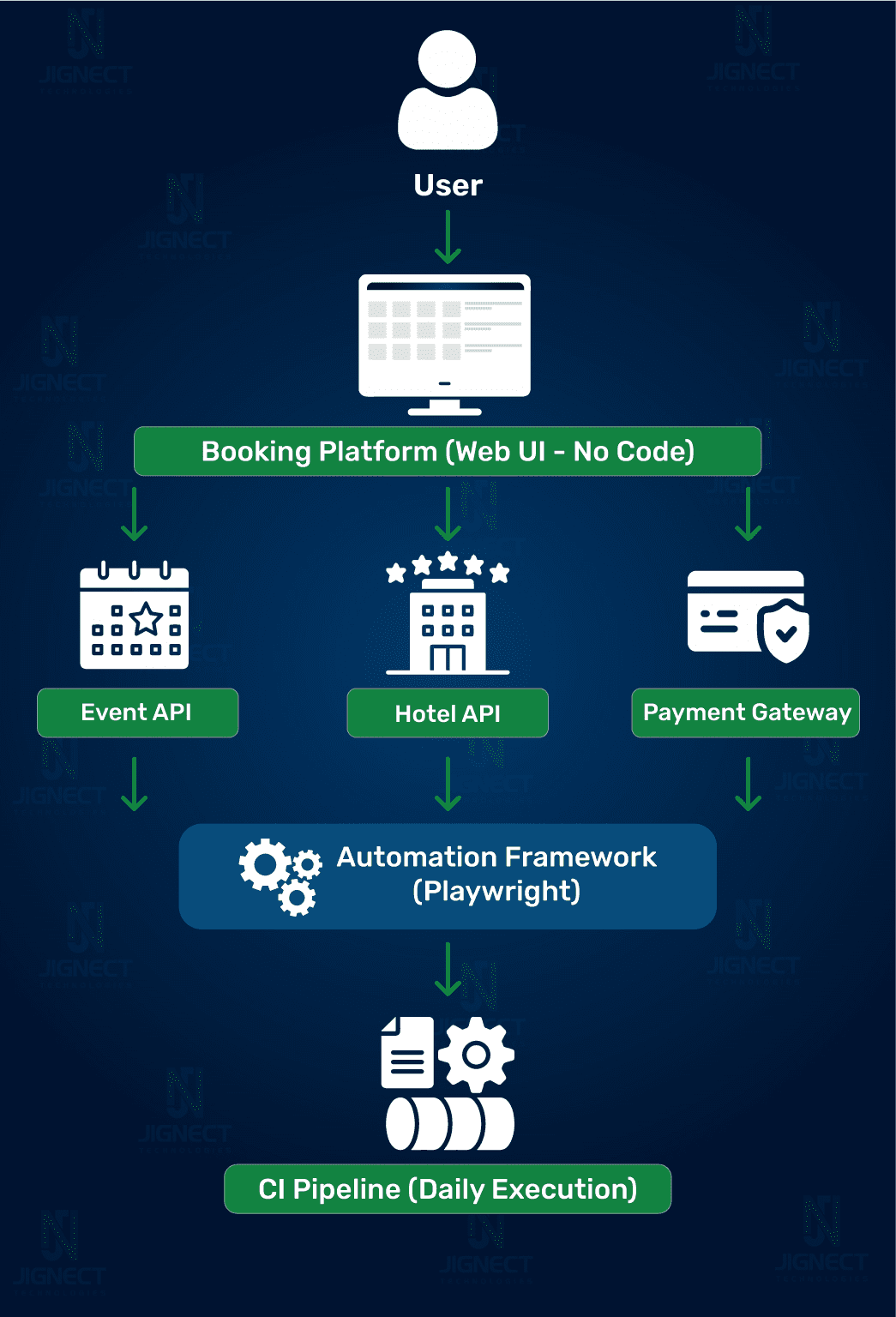
Enterprise Travel and Hospitality Platform – System & QA Architecture
Results & Impact
| Business Dimension | Measurable Impact |
| Critical Flow Coverage | ~80% automation across revenue-impacting workflows |
| Regression Risk | Substantially reduced across releases |
| Pricing & Inventory Accuracy | Early detection of API synchronization mismatches |
| Manual Validation Effort | Focused exploratory testing on high-risk business logic instead of repetitive regression |
| Release Predictability | Improved confidence through daily automated validation |
The hybrid framework delivered stable regression coverage despite the limitations of a no-code architecture, while manual validation ensured deep verification of complex business rules and integration edge cases.
Conclusion
This engagement demonstrates how structured quality engineering—combining strategic manual validation with scalable automation—can transform a complex, API-driven e-commerce platform into a stable and release-ready system.
By introducing scalable automation, strengthening exploratory testing for complex pricing logic, stabilizing dynamic UI behavior, and institutionalizing continuous validation, the platform achieved:
- Stronger production reliability
- Reduced financial and operational risk
- Faster and more predictable release cycles
- Increased stakeholder confidence in deployment decisions
The project stands as a strong example of delivering measurable QA value within technical constraints, aligning engineering validation directly with business-critical workflows while intelligently balancing automation with human-driven validation.
Witness how our meticulous approach and cutting-edge solutions elevated quality and performance to new heights. Begin your journey into the world of software testing excellence. To know more refer to Tools & Technologies & QA Services.
If you would like to learn more about the awesome services we provide, be sure to reach out.
Happy Testing 🙂