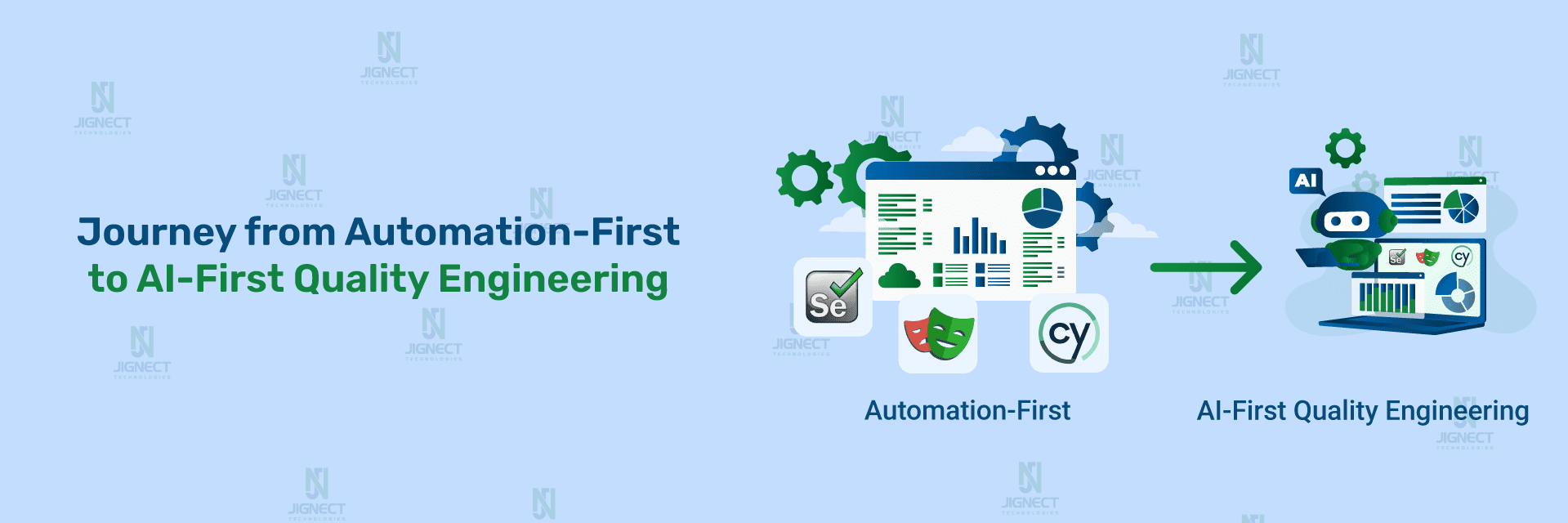

At Jignect, our journey toward AI-First Quality Engineering did not begin with a strategy meeting about artificial intelligence. It began with a much simpler realization. Even after years of investing in automation, our QA engineers were still spending a significant amount of time performing the same types of reasoning across projects. Every new engagement required similar steps: analyzing requirements, identifying testing risks, designing automation architecture, writing test cases, reviewing failure logs, and documenting strategies.
Automation had already solved the problem of repetitive execution. Our CI pipelines could run regression suites automatically. Our automation frameworks were stable and scalable. Releases moved faster than they did in the early days of manual QA. But something still did not scale as efficiently as we wanted. The part that remained manual was thinking.
Our engineers were repeatedly performing similar analysis across projects, industries, and system architectures. Over time, we realized that much of this reasoning followed recognizable patterns. Senior QA engineers asked the same types of questions when reviewing requirements. Automation architects designed frameworks using similar structural principles. Root cause analysis often followed predictable investigation paths. This observation eventually led us to a new idea. Instead of asking how AI could generate more test cases or run automated tests autonomously, we asked a different question:
What if AI could absorb the repetitive parts of quality engineering reasoning so our engineers could focus on complex system risks? This question became the foundation of our transition toward AI-First Quality Engineering at Jignect.
Today, our QA teams operate with a structured QA Prompt Library that captures institutional testing knowledge and allows engineers to accelerate requirement analysis, scenario design, automation architecture, and failure investigation using AI-assisted reasoning. This blog shares the story of how we built this system inside our organization, the lessons we learned during implementation, and how AI is now helping our engineers deliver deeper quality insights across projects.
- Phase One: When Manual QA Stopped Scaling
- Phase Two: Building an Automation-First QA Culture at Jignect
- When We Discovered Automation’s Hidden Limitation
- How the QA Prompt Library Was Born at Jignect
- The Structure of Jignect’s QA Prompt Library
- How Our Engineers Use Functional Testing Prompts at Jignect
- The Automation Prompt Library at Jignect
- Visual Diagram: Jignect AI-First QA Workflow
- AI in Root Cause Analysis at Jignect
- Applying AI-First QA Across Different Industry Domains
- AI as Institutional Memory for QA Teams
- Governance and Responsible AI Usage at Jignect
- Cultural Transformation: How QA Engineers Adapted to AI
- The AI-First Quality Engineering Model at Jignect
- What We’re Still Learning
- Conclusion: What AI-First Quality Engineering Means for the Future of QA
Phase One: When Manual QA Stopped Scaling
Like many engineering organizations, Jignect’s early QA workflows were heavily based on manual testing practices. Test cases were written in spreadsheets or test management tools. Regression testing was performed before release cycles. QA engineers manually verified workflows across different environments and reported defects through issue tracking systems.
For smaller applications and slower release cycles, this approach worked well. Our testers developed strong familiarity with product behavior and often identified usability gaps that were not captured in requirements.
However, as we began working with larger systems and clients across multiple domains-including healthcare platforms, financial systems, and enterprise applications-the limitations of manual testing became increasingly clear.
Regression cycles started growing longer with every release. Each new feature introduced additional testing scenarios that had to be verified manually. Teams often found themselves revalidating the same workflows repeatedly. More importantly, knowledge about system behavior often remained within individuals rather than being embedded into reusable systems. If a tester had deep knowledge about how a complex workflow behaved under certain conditions, that insight was rarely documented in a way that future teams could easily reuse.
We also observed that manual regression testing naturally focused on critical paths while leaving many edge cases unexplored. Testers prioritized validating primary workflows because of time constraints, which meant that deeper system risks were sometimes identified late in the development cycle.
Nothing failed dramatically. The manual QA model continued to function. But it became clear that it would not scale effectively as system complexity increased. This realization led us toward our next transformation.
Phase Two: Building an Automation-First QA Culture at Jignect
Once we stabilized our manual testing processes and understood the repetitive bottlenecks in regression cycles, the next logical step for us at Jignect was to introduce automation as a strategic capability within our quality engineering practice. Automation was never about simply replacing manual testing. Instead, our goal was to systematically automate the areas that delivered the highest value while maintaining stability and maintainability within the testing ecosystem.
Across our projects, we started by identifying workflows that were executed frequently in every release cycle. These included authentication flows, onboarding journeys, transactional workflows, and reporting functionality. These areas were ideal candidates for automation because they were both stable and critical to core business operations.
By prioritizing these workflows first, we were able to reduce repetitive manual validation and allow QA engineers to focus more on exploratory testing and complex edge cases.
Designing a Maintainable Automation Framework
As automation adoption increased, we quickly realized that the architecture of the automation framework would determine its long-term sustainability.
Instead of writing standalone automation scripts, we standardized our frameworks using layered design patterns that separated test logic, UI interaction, and data management. The foundation of our UI automation architecture was the Page Object Model (POM), which allowed us to isolate UI locators and page interactions within dedicated classes. This separation ensured that UI changes only required updates in page object files rather than across multiple test cases.
However, as our frameworks matured, we introduced additional patterns to improve structure and maintainability. One of the key improvements was the introduction of Data Objects. Rather than passing multiple parameters within test scripts, we created structured objects that represented entities used during testing. For example, a UserData object could store attributes such as username, password, and email. This approach made test scenarios more readable and organized. To support dynamic test environments, we also implemented a Data Factory pattern. Data factories generated test data dynamically, allowing our tests to create unique users, transactions, and records during execution. This eliminated data collisions and allowed our automation suites to run reliably in parallel environments.
Another important component of our framework architecture was the Utility Layer. Many automation operations-such as waiting for elements, generating random data, handling file uploads, or executing database queries-were commonly used across multiple tests. Instead of duplicating this logic, we centralized these helper methods within reusable utility files. This significantly reduced code duplication and kept our test files clean and focused on validating business logic.
Expanding Automation Beyond the UI Layer
As our automation capabilities matured, we also began shifting more validation toward API-level testing. API tests allowed us to validate backend logic directly without relying on the UI layer, making tests faster and less fragile. In addition, our automation frameworks incorporated database validation to ensure that system states matched expected outcomes after transactions were executed. This provided deeper confidence in the integrity of business workflows.
Automation suites were then integrated directly into our CI/CD pipelines, allowing regression tests to run automatically whenever new code changes were pushed to repositories. This provided faster feedback to development teams and significantly reduced release validation time. The impact was immediate. Regression cycles that once required days of manual execution could now complete within hours, enabling faster and more reliable releases.
When We Discovered Automation’s Hidden Limitation
As our automation frameworks matured, our test suites grew rapidly. More features meant more automated tests. Over time, maintaining automation became a significant engineering activity. But what surprised us most was something else.
Even though execution was automated, our QA engineers were still repeating many of the same cognitive tasks across projects. For example, requirement analysis followed similar reasoning patterns regardless of the application domain. Engineers consistently asked the same types of questions about validation rules, integration points, error handling, and security considerations. Similarly, when designing automation frameworks for new projects, our architects often recreated similar structures for page objects, fixtures, configuration layers, and reporting systems.
Failure investigation also followed predictable patterns. Engineers examined logs, analyzed stack traces, and determined whether failures were caused by product defects, automation instability, or environment issues. Over time, we realized something important. The biggest constraint in modern quality engineering was no longer execution speed. It was repetitive reasoning. And this insight eventually pushed us toward exploring AI.
How the QA Prompt Library Was Born at Jignect
Our initial experiments with AI began informally. Engineers occasionally used AI tools to help draft test cases, analyze requirements, or review logs. Some prompts produced useful insights, while others generated generic responses. But a pattern soon emerged.
When prompts were structured carefully-with clear context, constraints, and expected outputs-the results were significantly better. A few engineers began saving prompts that consistently produced useful results. Over time, those prompts were shared across teams. Eventually we realized that we were organically building something valuable: a collection of prompts that captured how experienced QA engineers reason about testing problems.
Instead of letting this knowledge remain scattered across individual engineers, we decided to formalize it. That decision led to the creation of what we now call the Jignect QA Prompt Library.
The Structure of Jignect’s QA Prompt Library
Today, our prompt library is organized into two major categories aligned with the QA workflow. The first category focuses on functional testing activities, while the second category focuses on automation engineering tasks.
Functional testing prompts help engineers analyze requirements, discover scenarios, identify gaps in specifications, and write structured test documentation. Automation prompts help engineers design frameworks, generate Page Object classes, create automation test files, and analyze automation failures.
Instead of starting from a blank page for every task, our engineers now begin with prompts that embed best practices and domain knowledge developed across multiple projects. This approach dramatically accelerates early QA activities while ensuring consistency in how testing strategies are designed.
How Our Engineers Use Functional Testing Prompts at Jignect
Once we formalized the Jignect QA Prompt Library, one of the first areas where it created immediate impact was requirement analysis. Traditionally, requirement analysis was an individual activity. A QA engineer would read the specification, write notes, identify test scenarios, and then discuss gaps with developers or product owners. While experienced engineers were very good at this process, the depth of analysis often depended on time availability and familiarity with the system.
At Jignect, we wanted to ensure that every requirement received a consistent baseline level of analysis before test design even began. To achieve this, we created a structured Requirement Analysis Prompt that our QA engineers now use as a starting point whenever a new feature specification arrives.
Instead of simply asking AI to generate test cases, the prompt guides the AI to think like a senior QA engineer. It asks the system to evaluate functional flows, identify edge cases, analyze potential risks, and highlight missing details in the requirement. Here is one of the actual prompt structures used inside Jignect for requirement analysis.
Example: Requirement Analysis Prompt
Act as a Senior Quality Assurance Engineer reviewing a software feature requirement.

Your goal is to analyze the requirement deeply and identify potential testing scenarios, risks, and missing considerations before development begins.

Instructions:
1. Carefully analyze the requirement.
2. Think like a QA engineer responsible for preventing production defects.
3. Consider functional flows, edge cases, error handling, data validation, security, and system dependencies.
4. Do not assume unspecified behavior - highlight missing information.

Provide the output in the following structured sections:

1. Functional Test Scenarios
- Core user workflows that must be validated.

2. Edge Cases
- Boundary conditions, unusual inputs, or system states that could cause unexpected behavior.

3. Negative Scenarios
- Invalid inputs, failure paths, and misuse cases.

4. Data Validation Rules
- Required validations for inputs, formats, ranges, and business rules.

5. Integration Risks
- External services, APIs, or system dependencies that may impact the feature.

6. Security Considerations
- Authentication, authorization, data exposure, and misuse risks.

7. Concurrency or State Risks
- Race conditions, duplicate actions, retries, or multi-user conflicts.

8. Observability Needs
- Logs, monitoring, or events that should exist for debugging.

9. Clarification Questions for Product or Engineering Teams
- Important questions QA should raise before development begins.

Requirement:
<User inserts feature requirement here>
When this prompt is used, the AI generates an initial set of scenarios covering common risks such as insufficient balance conditions, duplicate transaction attempts, concurrency issues, validation of transfer limits, and security concerns around authorization.
Our QA engineers then review these outputs and expand them based on system architecture and business context. This approach provides a structured starting point for test design, ensuring that critical risk areas are considered early.
The key point is that the AI output is not treated as final documentation. Instead, it acts as a reasoning accelerator that allows engineers to explore a broader scenario space more quickly. Over time, this has significantly improved the quality of early QA involvement during feature planning.
Requirement Gap Analysis: Catching Problems Before Development Begins
Another prompt that has become widely used within Jignect is our Requirement Gap Analysis Prompt. Many requirement documents focus primarily on describing the intended functionality of a feature but omit important operational details. These missing elements often surface later during testing or even after deployment.
By applying structured prompts during the requirement review stage, our QA teams can identify potential gaps much earlier.
Example: Requirement Gap Analysis Prompt
Act as a QA Lead reviewing a product requirement before development begins.

Your objective is to identify missing information, ambiguities, and risks that could lead to defects if left unresolved.

Analyze the requirement and identify gaps across the following dimensions:

1. Functional Behavior
- Missing workflow steps
- Undefined outcomes

2. Validation Rules
- Input validation
- Business rule constraints
- Data format requirements

3. Error Handling
- Failure scenarios
- System responses
- User feedback messages

4. System Limits
- Rate limits
- Maximum values
- Size constraints
- Timeouts

5. User Permissions
- Roles and access levels
- Unauthorized access behavior

6. Integration Dependencies
- External services
- API dependencies
- Data synchronization issues

7. State Management
- Behavior during retries, refresh, or concurrent usage

8. Performance and Scalability Considerations
- High load scenarios
- Transaction spikes
- Large datasets

9. Security and Compliance Risks
- Sensitive data handling
- Authorization enforcement
- Logging and auditing

Output Format:

Section 1: Identified Requirement Gaps
Section 2: Potential Risks If Gaps Are Not Addressed
Section 3: Questions QA Should Raise During Requirement Review

Requirement:
<Insert requirement here>
Using this prompt during requirement reviews frequently uncovers issues such as undefined validation rules, missing error responses, or unclear system constraints.
For example, in financial transaction systems, the requirement might state that users can transfer funds between accounts, but it may not specify limits on transfer amounts, behavior during network interruptions, or how duplicate requests should be handled. Raising these questions early allows product and engineering teams to clarify behavior before development begins, which ultimately reduces late-stage defects.
AI-Assisted Test Case Generation in Real Projects
Once requirements are analyzed and gaps are identified, the next step in the QA process is test case design. Writing test cases manually has always been a time-consuming activity, particularly when features contain many similar validation scenarios. At Jignect, we developed prompts that generate structured test case drafts which engineers then refine and validate.
Example Prompt for Test Case Drafting
Act as an experienced QA engineer responsible for creating comprehensive test coverage for a feature.

Based on the provided feature description, generate structured test cases that cover both normal workflows and risk scenarios.

Guidelines:
- Ensure coverage of positive, negative, and edge scenarios.
- Consider user behavior, validation rules, and system responses.
- Avoid duplicate scenarios.
- Prioritize test cases based on risk.

Output Format:

For each test case include:

Test Case ID
Title
Priority (High / Medium / Low)
Test Type (Functional / Validation / Negative / Edge)
Preconditions
Test Steps
Expected Result

Feature Description:
<Insert feature description here>
The generated output includes multiple scenarios such as valid login, invalid password attempts, locked account conditions, and empty field validations. Our engineers then review these drafts and adjust them to reflect system-specific behaviors. This method significantly reduces time spent writing repetitive documentation while still ensuring that QA engineers maintain ownership of the final test design.
The Automation Prompt Library at Jignect
While functional testing prompts improved requirement analysis and documentation processes, we soon realized that AI could also assist with automation engineering tasks. Automation frameworks require engineers to repeatedly design similar project structures. Page Object classes, configuration layers, fixtures, and reporting mechanisms often follow recognizable patterns.
To reduce the time spent building these structures from scratch, we created a set of prompts dedicated to automation framework generation and code scaffolding. These prompts help engineers quickly generate baseline framework structures for new projects.
AI-Assisted Automation Framework Design
One of the most widely used automation prompts inside Jignect helps engineers design automation frameworks based on the system architecture of the application under test.
Example: Automation Architecture Prompt
Act as a Senior Test Automation Architect designing a scalable automation testing strategy for a modern web application.

Analyze the technology stack and propose a maintainable automation architecture.

System Details:
Frontend:
Backend:
Database:
Messaging / Event Systems (if any):

Provide the following:

1. Recommended Automation Strategy
- Testing layers (UI, API, database)
- Test pyramid distribution

2. Automation Framework Architecture
- Key design principles
- Maintainability strategy

3. Suggested Folder Structure
- Page objects
- Test files
- Test data
- Utilities
- Configuration
- Reporting

4. Design Patterns to Use
- Page Object Model
- Data Object pattern
- Data Factory pattern
- Utility / helper layers

5. CI/CD Integration Strategy
- When tests should run
- Parallel execution approach

6. Reporting and Observability
- Test reports
- Failure diagnostics
- Logs and screenshots

Explain the reasoning behind each recommendation.
The output generated from this prompt typically recommends a layered testing approach where UI tests validate core workflows, API tests verify business logic, and database assertions confirm system state.
This prompt helps engineers begin projects with a structured automation strategy rather than building frameworks purely from habit.
Generating Page Object Classes Using AI
Another common use case within the Jignect automation prompt library involves generating Page Object Model classes. Instead of manually writing the same boilerplate structures repeatedly, engineers use prompts to generate baseline classes which are then customized.
Example Prompt
Generate a production-ready Page Object Model class for a web application page.

Requirements:
- Use clean automation design practices.
- Separate locators from interaction logic.
- Include reusable methods rather than single-step actions.
- Include validation methods.

Technology:
Playwright with TypeScript

Page Description:
Login page containing:
- Email input
- Password input
- Login button
- Error message container

Output Requirements:

1. Page Object class
2. Locator definitions
3. Page interaction methods
4. Validation methods
5. Comments explaining key design choices
AI-generated output typically includes structured classes that follow modern automation best practices. Engineers then adapt these classes to match application-specific selectors and behaviors. This approach speeds up the initial stages of automation development while preserving engineering oversight.
Visual Diagram: Jignect AI-First QA Workflow
Below is a simplified diagram representing how AI is integrated into the QA workflow at Jignect.
Requirement Document
       ↓
AI Requirement Analysis
       ↓
QA Engineer Review
       ↓
Scenario Expansion
       ↓
Test Case Draft Generation
       ↓
Automation Strategy Design
       ↓
Automation Development
       ↓
CI Pipeline Execution
       ↓
AI Failure Analysis
       ↓
Engineer Investigation
This workflow allows AI to assist in reasoning-heavy tasks while engineers retain control over final decisions.
AI in Root Cause Analysis at Jignect
Automation failures are inevitable in complex software systems. When tests fail, engineers must determine whether the issue originates from the application, test scripts, environment instability, or test data inconsistencies. Traditionally, this investigation required manual log analysis.
At Jignect, we created prompts designed specifically to analyze failure logs and categorize potential causes.
Example Root Cause Analysis Prompt
Act as a QA automation engineer investigating a failing automated test.
Analyze the failure logs and determine the most likely root cause.
Steps:
1. Review the error message and stack trace.
2. Identify the failing test step.
3. Determine whether the failure is likely caused by:
   - Application defect
   - Automation script issue
   - Test data problem
   - Environment instability
   - Timing or synchronization issue

Output Format:
- Failure Summary
- Likely Root Cause Category
- Reasoning Behind the Classification
- Evidence from the Log
- Recommended Next Investigation Steps
- Possible Fix Suggestions

Failure Log:
<Insert log here>

This approach helps engineers focus their investigation efforts more efficiently. Instead of starting from scratch, they begin with AI-generated hypotheses and validate them through deeper analysis.
Applying AI-First QA Across Different Industry Domains
Jignect works with clients across multiple industries, including healthcare platforms, financial systems, and enterprise applications. Each domain introduces unique testing challenges. To ensure that AI outputs remain context-aware, we created domain-specific prompts within our library.
For example,
- healthcare systems require validation around patient data privacy, audit logging, and regulatory compliance.
- Financial platforms require strong emphasis on transaction integrity, concurrency behavior, and fraud prevention scenarios.
By embedding these domain considerations into prompts, we ensure that AI-generated scenarios align with real-world industry risks.
AI as Institutional Memory for QA Teams
One unexpected benefit of building the QA Prompt Library was its role as a form of organizational memory. Over time, experienced QA engineers accumulate deep knowledge about system behavior, testing strategies, and failure patterns.However, without structured documentation, this knowledge often remains informal. By converting testing insights into reusable prompts, Jignect effectively captures these reasoning patterns in a form that can be reused across projects.
New QA engineers joining the organization can learn faster because they can access prompts that encode best practices developed through years of project experience. This transforms quality engineering knowledge from something that exists only in individuals into something that exists within the organization itself.
However, we recognize that prompts alone are not sufficient. Our competitive advantage lies in the continuous feedback loop: engineers use prompts, refine them based on real project outcomes, and contribute improved versions back to the library. This creates a learning system that becomes more valuable over time-not a static document that degrades as technology changes.
Governance and Responsible AI Usage at Jignect
Adopting AI within engineering workflows requires careful governance. At Jignect, we follow several principles when integrating AI into our QA processes.
- First, AI outputs are always treated as drafts rather than final deliverables. Engineers remain responsible for validating results and making final decisions.
- Second, sensitive information such as client data or proprietary system details is never shared directly within prompts.
- Third, prompts within the library undergo periodic review to ensure they remain accurate and aligned with current engineering practices.
These guidelines ensure that AI enhances productivity without compromising security or engineering accountability.
Cultural Transformation: How QA Engineers Adapted to AI
Perhaps the most significant aspect of our transition to AI-First Quality Engineering was not technological-it was cultural.
QA engineers had to develop new skills in prompt design and AI output evaluation.
Instead of spending all their time writing test cases or analyzing logs manually, engineers began focusing more on reviewing AI-generated insights and refining them based on system understanding.
This shift changed the role of QA engineers from primarily executing testing tasks to designing quality strategies.
AI became a collaborator that handled repetitive reasoning tasks, allowing engineers to concentrate on deeper architectural and risk analysis.
The AI-First Quality Engineering Model at Jignect
Today, quality engineering at Jignect operates as a layered system where automation, AI, and human expertise each play a distinct role.
Automation Layer
Runs regression tests across environments
↓
AI Reasoning Layer
Analyzes requirements, logs, and testing data
↓
Human Engineering Layer
Validates insights and designs testing strategy
This layered approach allows us to scale quality engineering across multiple complex projects without overwhelming individual engineers.
What We’re Still Learning
This transition hasn’t been without challenges:
- Not all QA tasks benefit equally from AI assistance (exploratory testing still requires deep human intuition)
- Prompt quality varies based on how well context is provided
- We’ve had to invest in training engineers to think about “prompt design” as a skill
- Some clients initially questioned whether AI-generated test scenarios were thorough enough (we now share our review process upfront)
We see these as part of the maturation process, not roadblocks.
Conclusion: What AI-First Quality Engineering Means for the Future of QA
Our journey from manual testing to automation-first engineering and eventually to AI-assisted QA has reshaped how we approach software quality at Jignect.
Automation enabled us to scale execution. AI is now helping us scale reasoning.
By transforming testing knowledge into structured prompts, we have created a system where engineering insights can be reused, refined, and applied across projects. The result is a QA practice that becomes more intelligent over time.
As AI capabilities continue evolving, we expect the role of quality engineers to become increasingly strategic. Instead of focusing primarily on execution, QA professionals will focus on understanding system risk, designing resilient architectures, and ensuring that software behaves reliably under real-world conditions.
At Jignect, we believe that the future of quality engineering lies not in replacing testers with AI, but in empowering engineers with tools that amplify their ability to think, analyze, and anticipate risk. And that future has already begun.
Witness how our meticulous approach and cutting-edge solutions elevated quality and performance to new heights. Begin your journey into the world of software testing excellence. To know more refer to Tools & Technologies & QA Services.
If you would like to learn more about the awesome services we provide, be sure to reach out.
Happy Testing 🙂